Wrapup
Congratulations to the 15 in-person teams and 98 100 remote teams who finished the hunt!
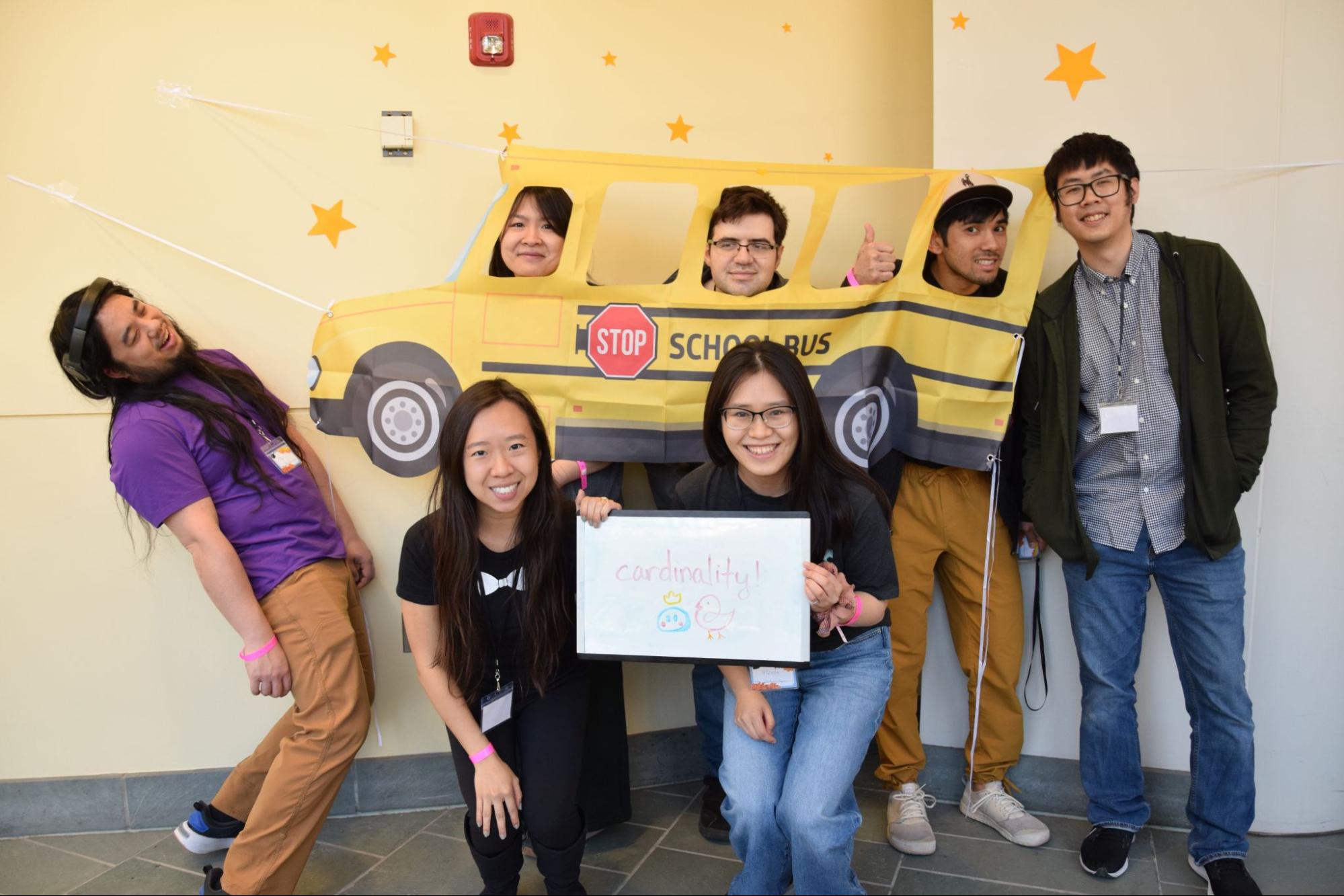
Congrats to our winning in-person team, The WugWug WugWug, and our first in-person finishers, Cardinality!
Another congratulations to our first remote finishers, ⛈️ Thunderspeaker Thursday 🗣️‼️😶🌫️🙉🙄!
Quick Summary
Solve Graphs (Finishers)
Theme & Story
By Kevin Jaeger and Isaac McGreevy
The theme for BPH26 was college! The initial theme that had been decided on (before both heads of story had joined the writing team) was “the open curriculum,” but since that mostly applied to unlock structure, the story morphed into being about a college for puzzle solvers.
Kickoff
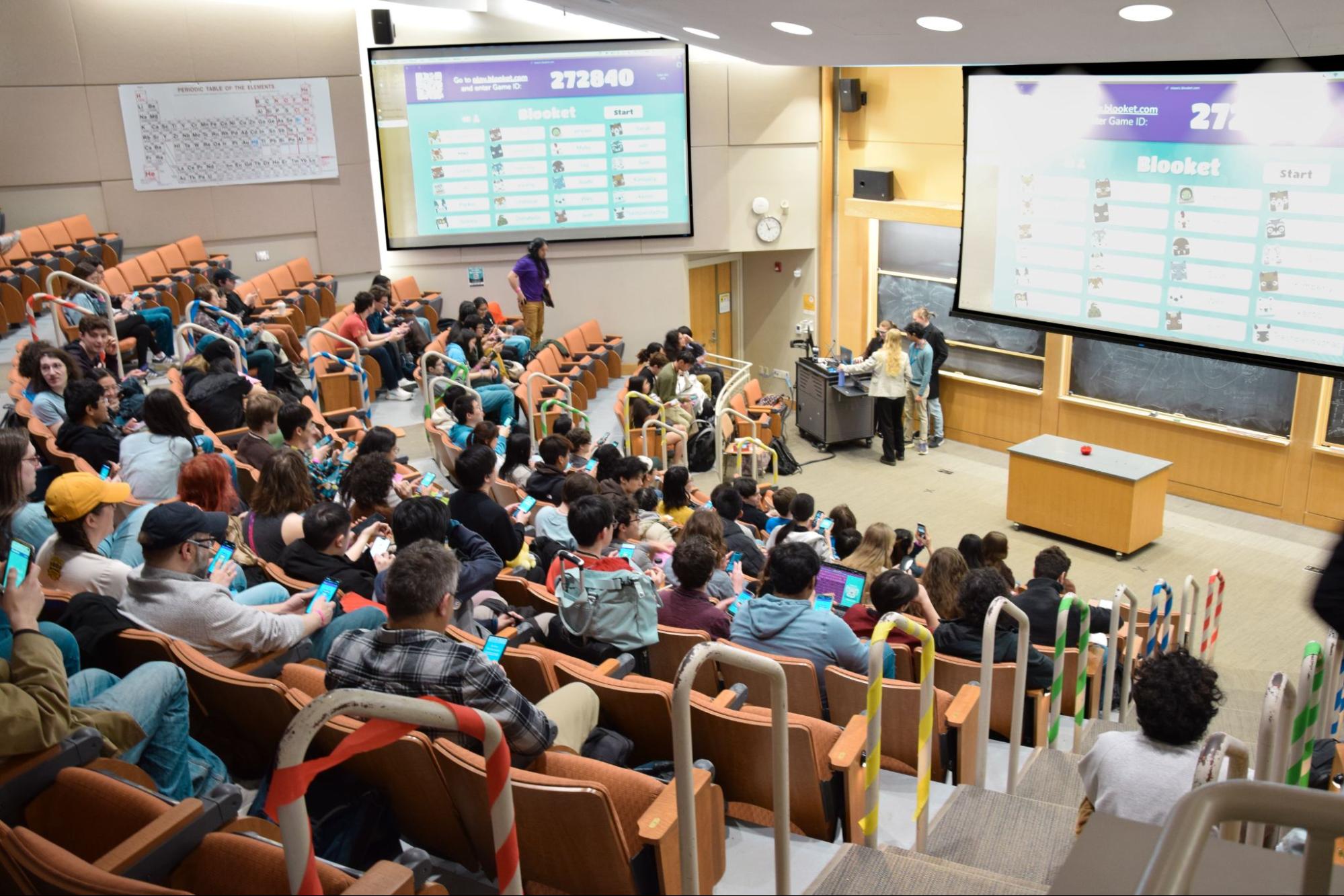
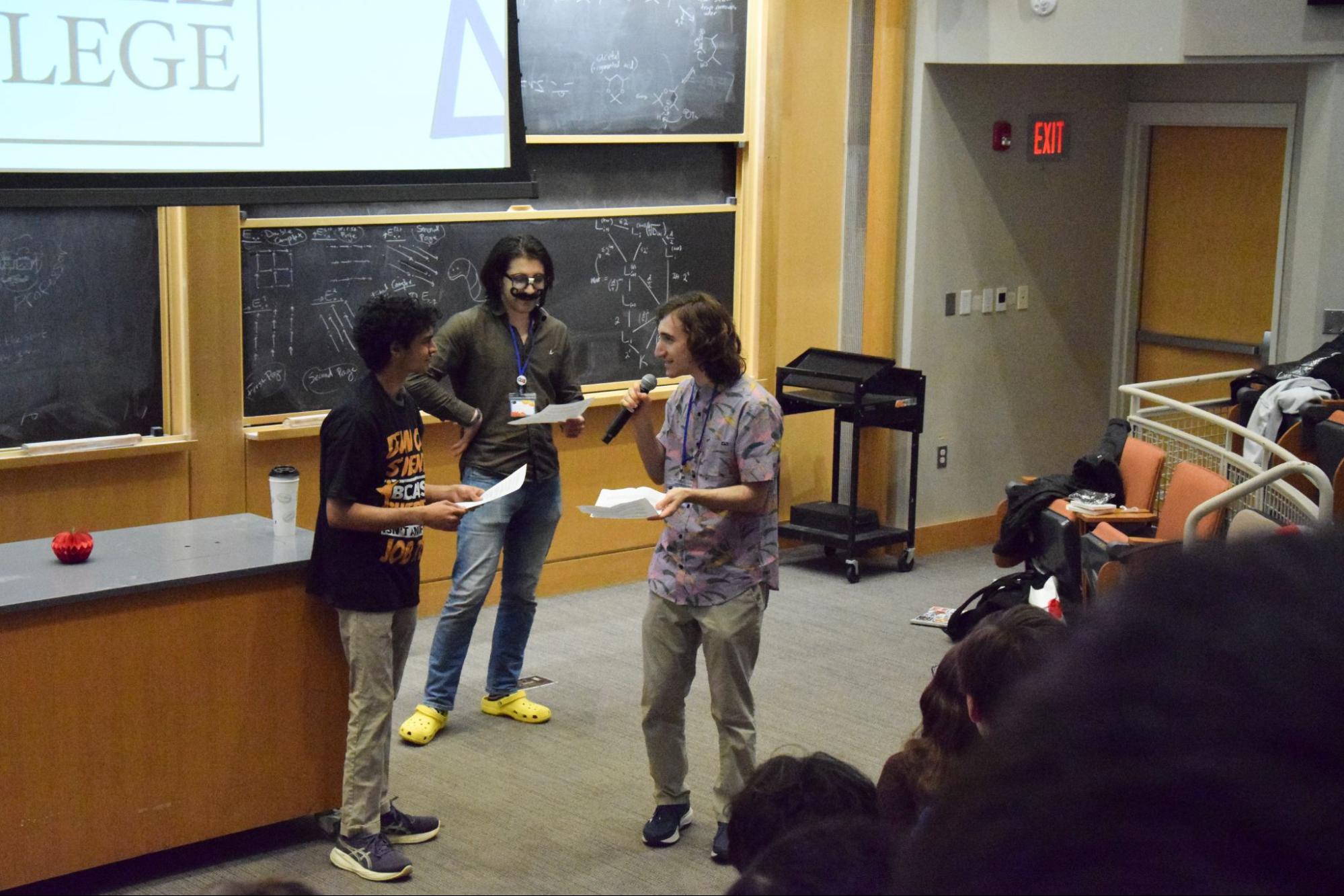
This year, the kickoff script was centered around a college orientation at Brown Puzzle College. Partway through the orientation, a student interrupted to complain about their ursine roommate assignment and demanded a room swap, leaving the solvers with Blueno as their roommate. The script was actually written two nights before the hunt, so take that, BPH2025! We want to thank our actors Arnav, Aren, and Noah for doing an incredible job bringing our skit to life, alongside some amazing improvisation that made us laugh harder than it perhaps should have.
Interactions
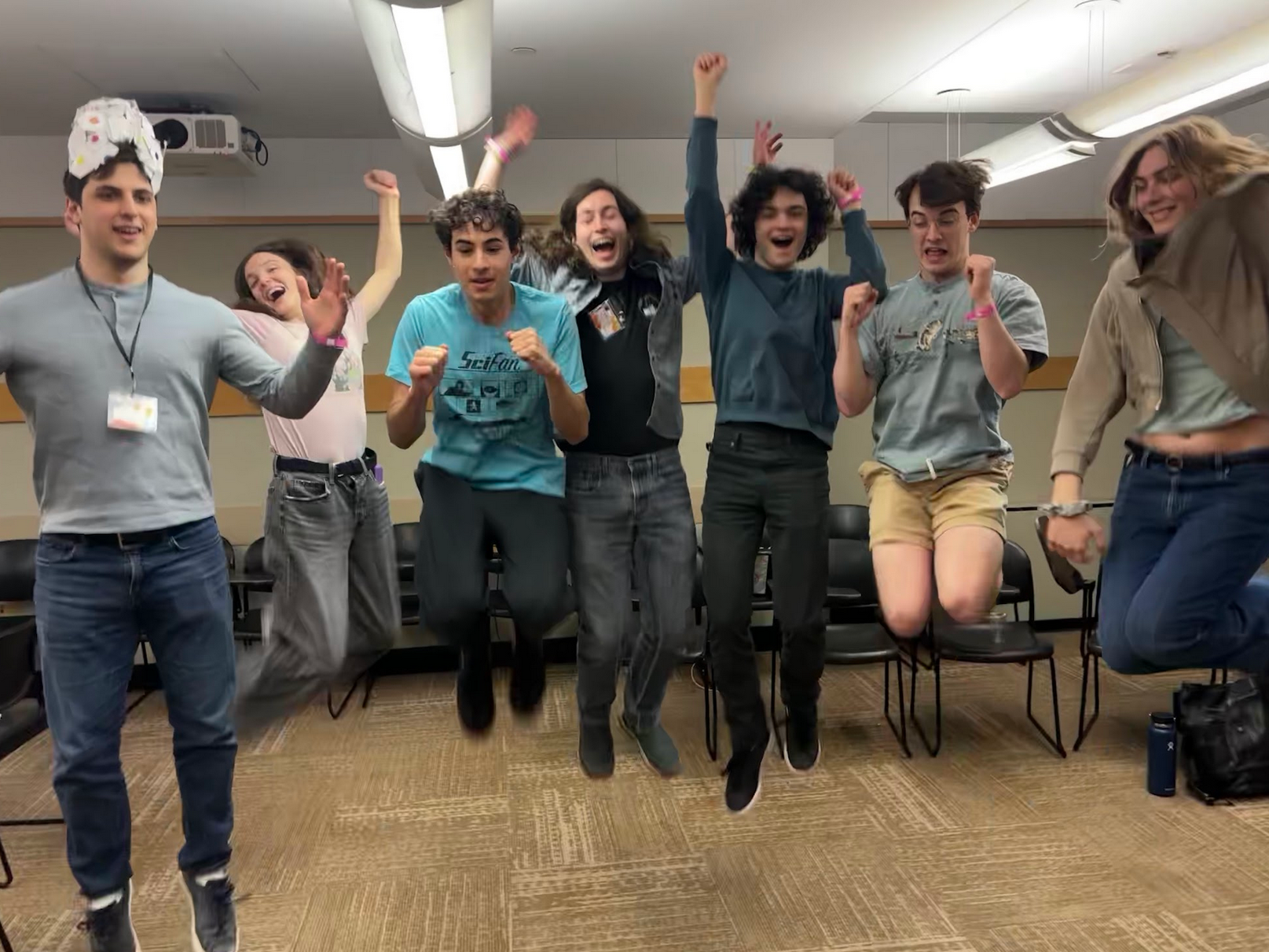
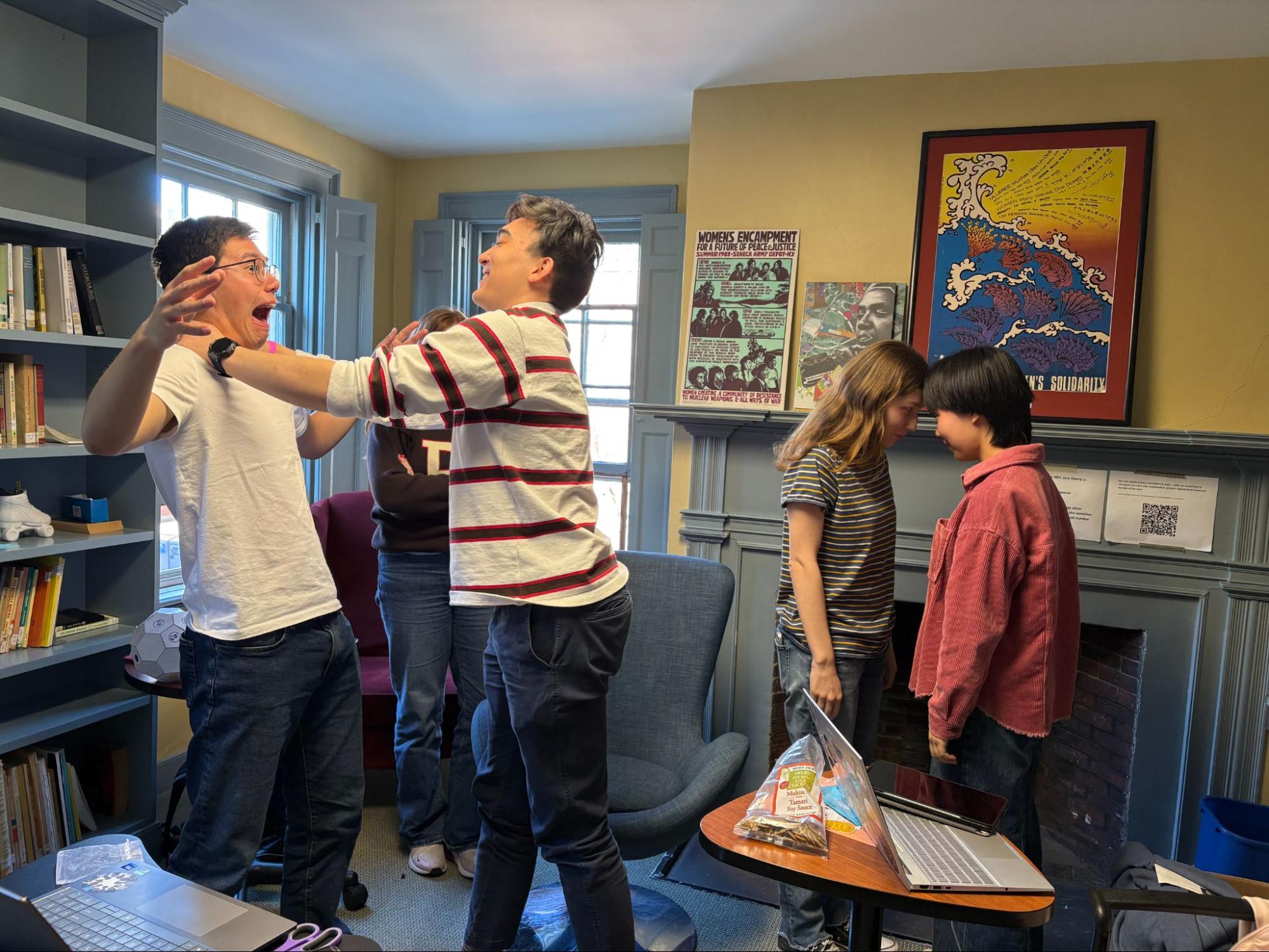
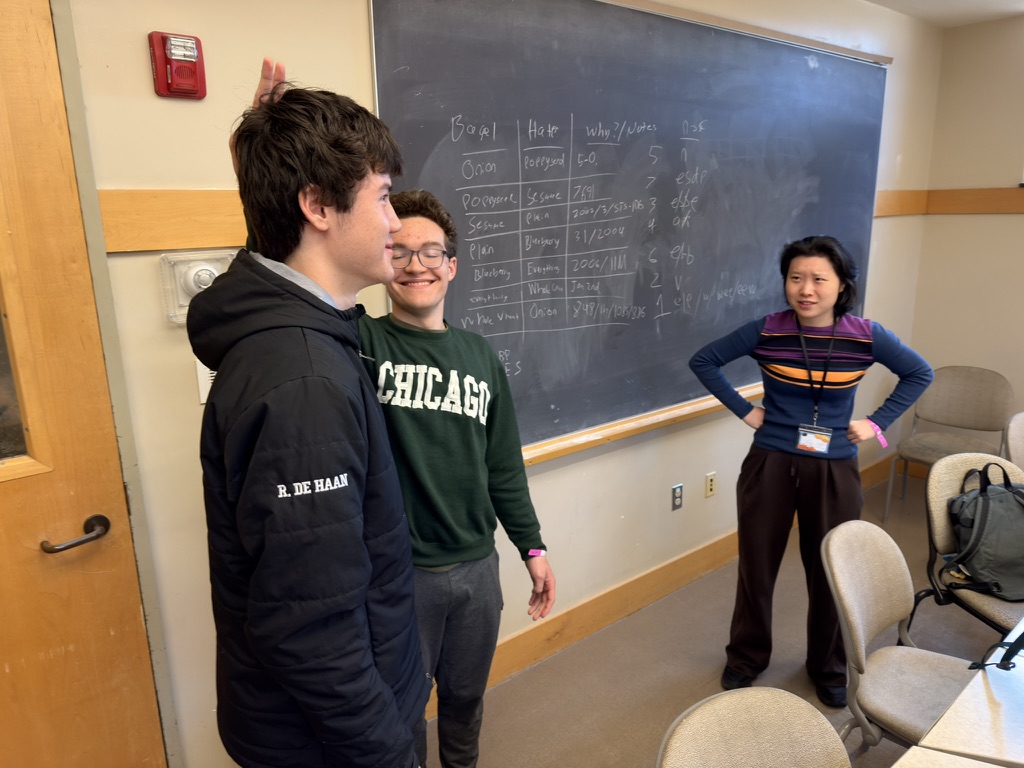
We held two variations of an interaction this year. The Brown teams were assigned to pose for photos for an “End of Year” social media post. The prompts for posing were silly, but the creativity of the teams is what made the pictures truly great. The non-Brown teams were assigned to give a speech to commemorate the accomplishment of completing their first degree. The catch was that all the solvers in a team had to work as a group, where each person could only contribute one word at a time, and try to meet certain speech requirements, such as starting off with “Webster’s dictionary defines…” and thanking multiple entities. After each team successfully completed their task, they were awarded with a graduation Blueno pin.
Blueno
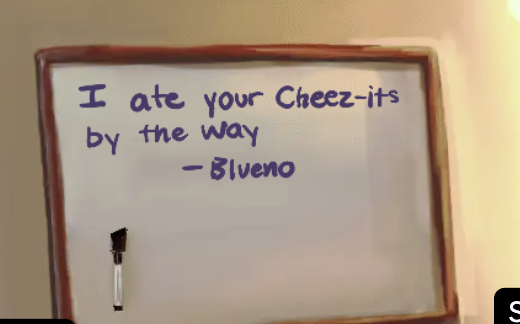
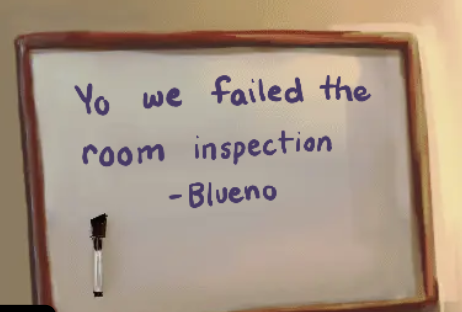
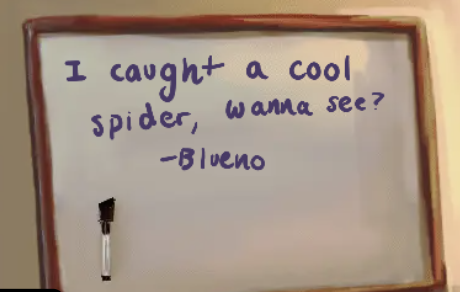
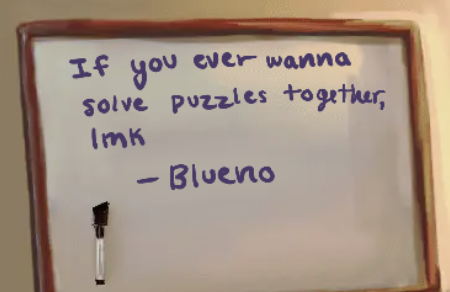
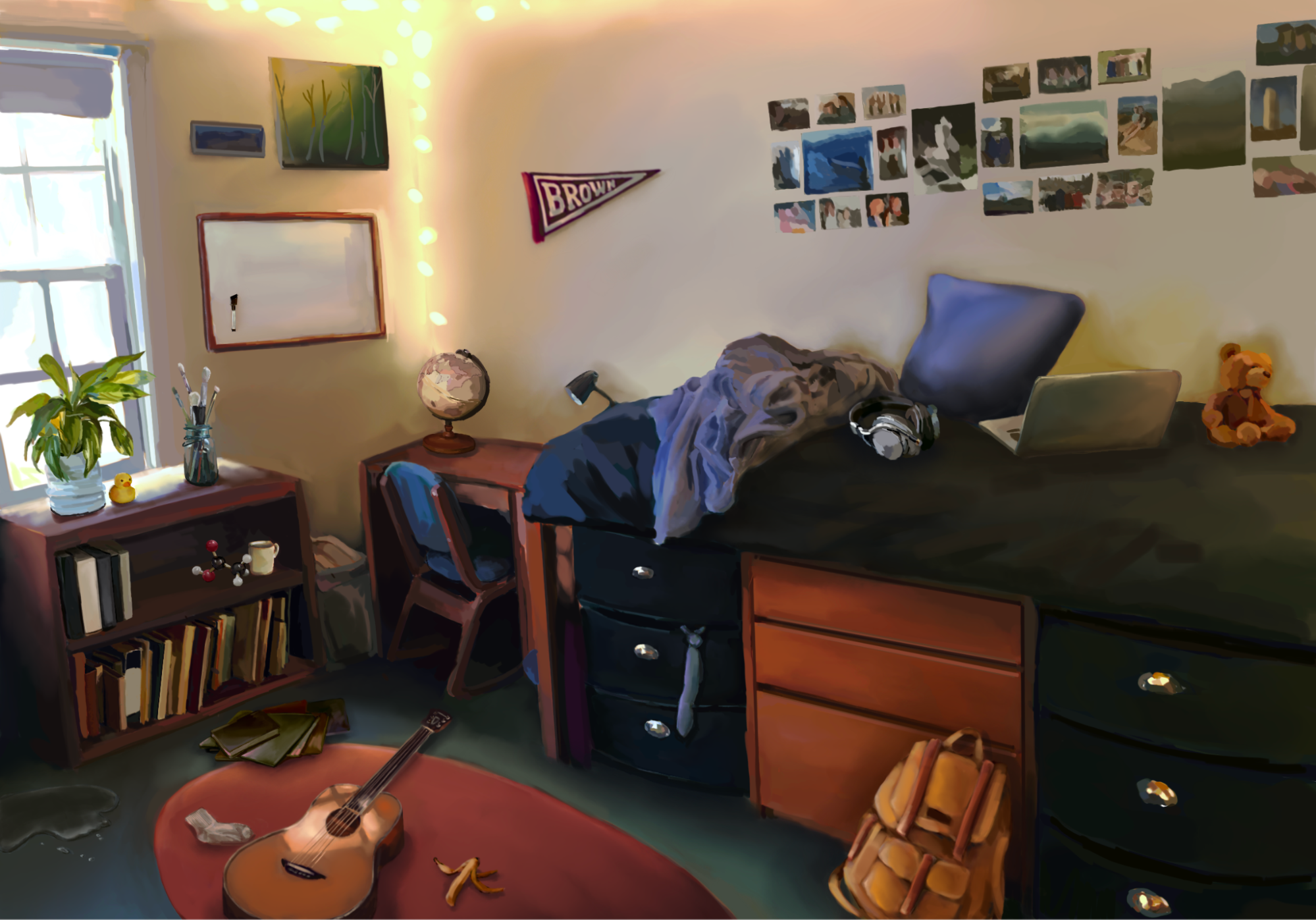
As BPH tradition, we felt we had to include Blueno in the story somehow. When Blueno was first introduced, they were portrayed as a terrible roommate based on the notes they left for you on your whiteboard, as well as the mess they left on the floor. As teams progressed throughout the hunt, Blueno’s messages would get better and better, and the mess would start getting cleaned up. By the end of the hunt, teams would have seen Blueno change from an awful roommate to a great one, and they would have also learned that Blueno was the mystery prodigy student they were academically competing against the whole time. The past three years of BPH saw Blueno as a villain, so this year we wanted Blueno to start as a villain and turn into a surprise hero of sorts.
Runaround
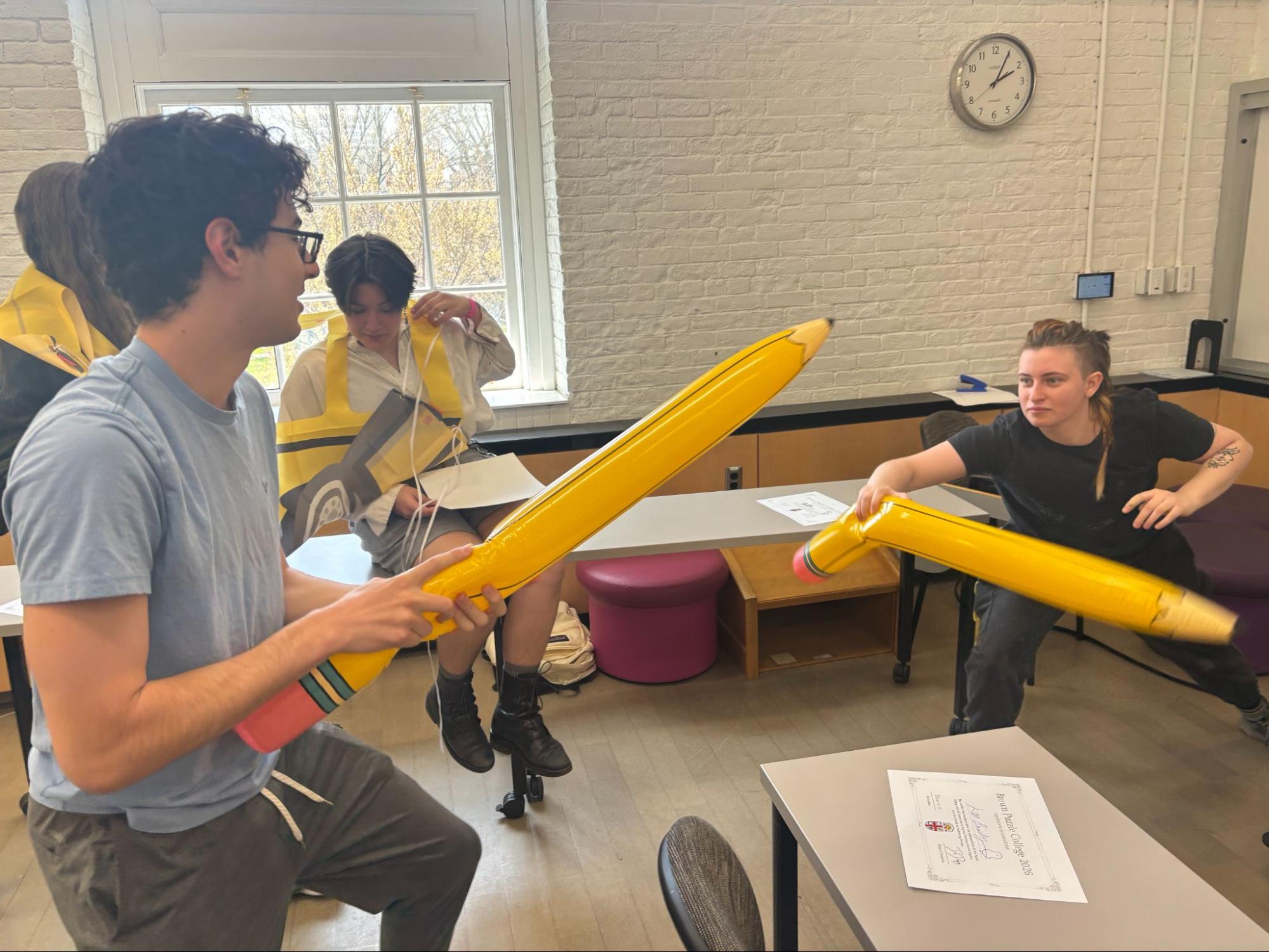
After teams finished solving their final meta, they were alerted that Blueno had lost their thesis draft and needed help finding it. Hopefully, teams became fond of Blueno by the end of their hunt, so they were willing to help. They would have to find Blueno’s thesis draft (puzzle), which they would then have to solve. Upon solving, the teams realized that Blueno’s thesis was beyond bad, and they would have to go to a thesis advisor to get advice to improve it. Once they solved the thesis advisor’s puzzles and extracted the advice, they would send the advice to Blueno and get on with their own thesis, using the strange meta answers to describe their time at BPC. Finally, the teams would be congratulated by Dean Dan Dawgz for their outstanding work in both helping Blueno out and writing their own thesis, being awarded the role of valedictorian, signifying their final academic triumph over Blueno.
We’d like to thank everyone who helped out the story team this year, including Malcolm, for the unique theme idea, Erin and Arnav, for their great ideas during our writing meetings, Megan, for keeping us on track and buying goofy costumes, Eliot, for doing a wonderful job with the social media and marketing, Chloe and Bailey, for their beautiful main page and puzzle page art, and all the actors for their inspiring performances during kickoff, interaction, and runaround. We seriously couldn’t have done it without y’all. :)
Art Direction
By Bailey Merlino
Art this year was a lot more chill and straightforward than the previous year. We spent most of our time in the fall waiting for metas to be finalized and then tackled the department pages while Chloe worked on the Home Page. We all then spent a month or two working on the backpack sprites and the final couple months working on various requests as I finished up the main page art. Compared to last year (with the map…), every aspect went smoothly and I’m super proud of how it turned out!
Home Page
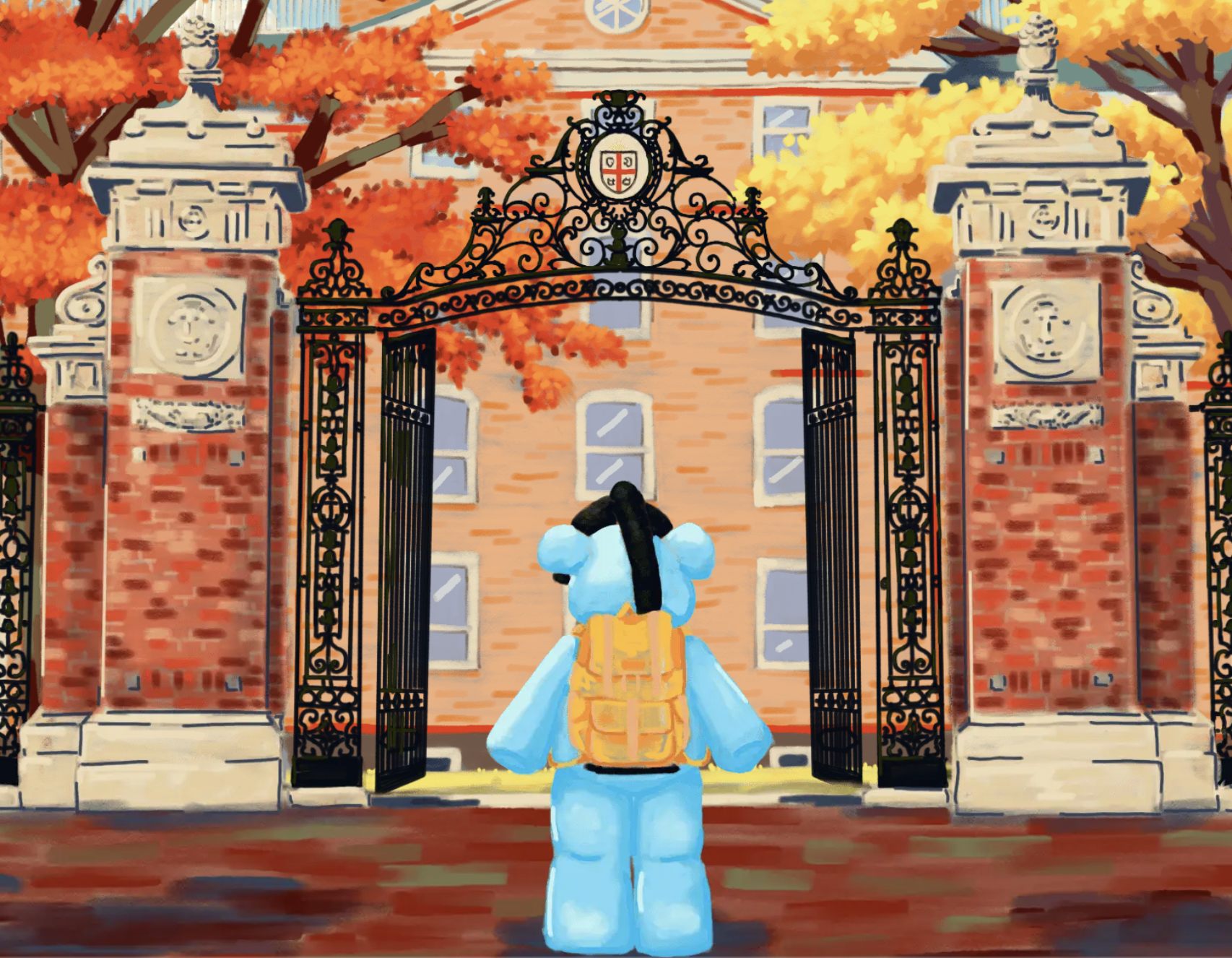
We had the idea for the home page to be the convocation ceremony, a tradition at Brown where you enter the Van Wickle gates to signify the start of your academic career. Chloe did an amazing job bringing this vision to life and it became the central work that we based the other art around. There was a lot of tweaking that had to be done to accommodate tech, including a parallax ask and inclusion of the title written in the clouds that Chloe was wonderful at accommodating.
Main Page
We deliberated on what the main page should look like for the better half of a month. It was originally just going to be a bookshelf or a desk, but the idea to make it a dorm room felt more natural with the direction that story was going in. Fun fact, it is modeled after a real Brown dorm. We wanted the main page to be dynamic with moving elements, including messy items that would be cleaned up as you progressed through the story and changing whiteboard messages that got nicer as you grew closer to your roommate (Blueno). The inclusion of the singular sock is Kevin’s fault. I really enjoyed rendering the room and opted for a more painterly style. I had a lot of fun designing the room and coming up with the icons for the departments was a unique challenge.
Backpack
This year to display our metas we decided to have them be pin icons on a backpack, which meant that every artist got to contribute to one larger work overlayed on top of Jackie’s beautiful yellow backpack. It was an exciting development from the sprites on last year’s map, as I felt these were more visible and cohesive despite being made by all different artists.
Departments
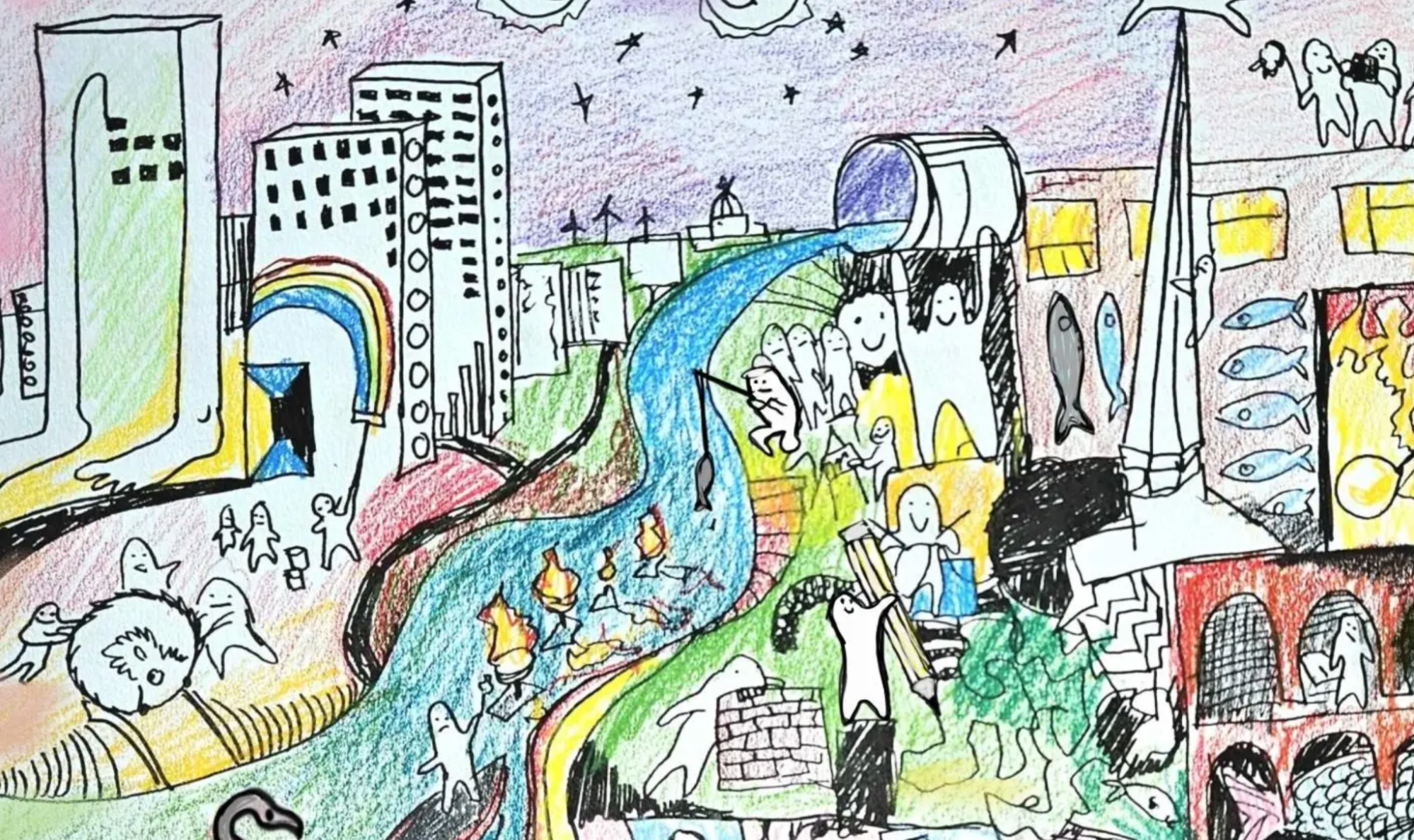
As the different puzzles were organized into departments this year, we wanted to create works that represented the essence of each “major.” So for history/literature that was books, for performing arts a theater, and for business was naturally coloring pages. Special thanks to Thea, Amara, and Jackie for contributing to these department pages. The RISD page made by our resident RISD student, Phil, was a highlight of this year’s art for me personally.
Other Fun Stuff 😎
Date Everything Brown was an idea born from Veronika that included the unique challenge of creating datable characters a la Date Everything. This meant making objects or buildings around the Brown campus into hot singles looking for love, a task we all approached gleefully. Again, I was grateful to have a task that we could all work collaboratively on and contribute everyone’s styles, which is always the most fun part of working as a team.
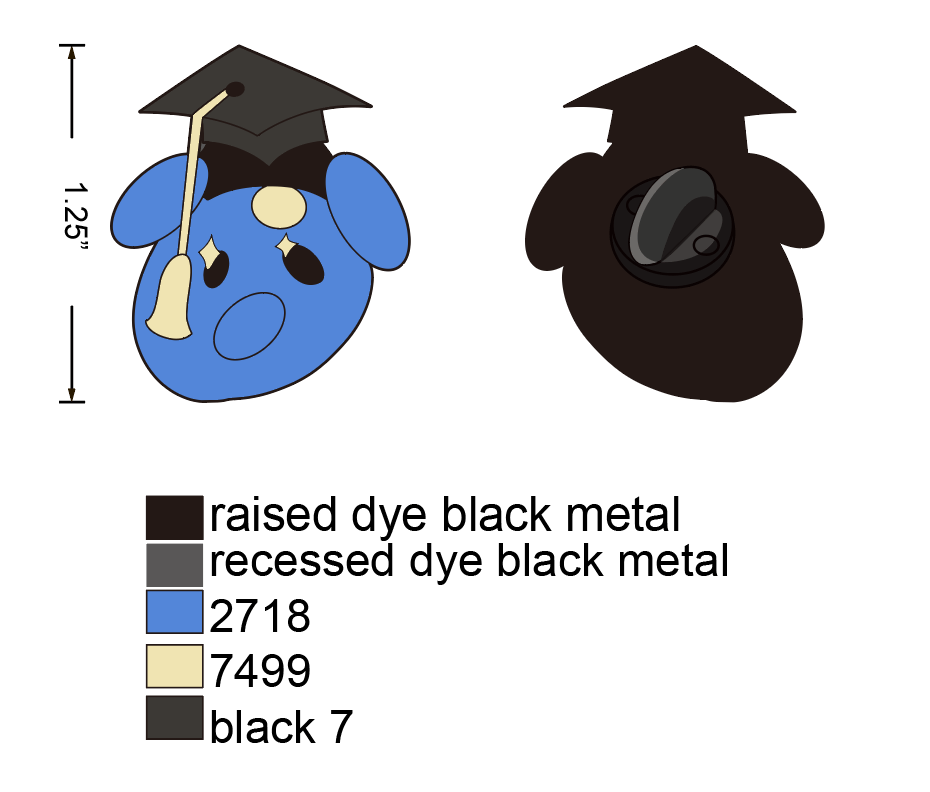
This year’s pin was made by Jackie! We used it in a story interaction, which was cool to give in person solvers a reward for their progress that is more accomplishable than finishing the hunt.
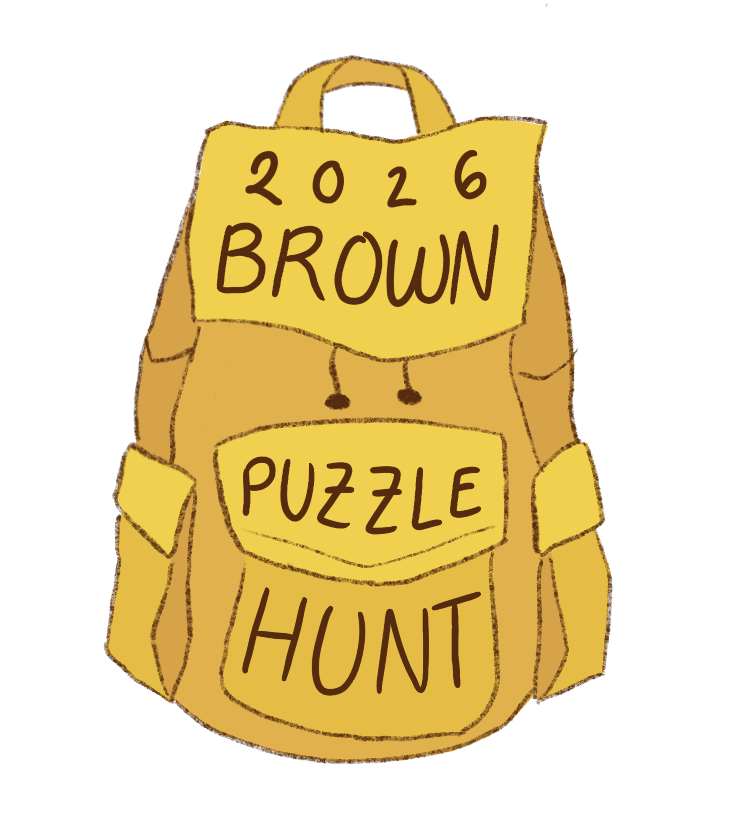
In the same vein, Thea made this year’s sticker. She depicted Blueno’s now iconic yellow backpack to represent the meta round art.
Tech
By Alex Wang and Chloe Qiao
Interactive Puzzles
This year’s hunt featured several interactive puzzles. Hopefully they were usable enough.
Topics in Guard-Door Theory
Originally, to keep all data server-side, the client called a server action on every move. We later decided that move thresholds were not particularly sensitive and could be leaked to the client. Thus, we optimized the system so that (1) puzzles whose thresholds have been met do not trigger updates, (2) puzzles call the server action only on identical threshold matches, and (3) once a team unlocks all minigames, no more checks occur. The server action takes and reverifies the entire move sequence before unlocking new minigames.
Analogical Semantics
To make the warming process faster, we used V8 to serialize and deserialize the word and vector objects.
By the way, we can see when you’re botting. The Python requests library has its own user agent. Please be nice. Unfortunately, Vercel charges just as much for an API call as for a page load.
Escapism in Cinema
The original draft of Escapism in Cinema had “small” chain nodes and “big” chain nodes. We made many tweaks to the UI to make it usable on the web. Big thanks to all our testsolvers for their feedback.
How to Get Your Heart Broken
This puzzle featured a dating simulator. Big thanks to Veronika, the puzzle author, who also took charge of the tech implementation.
Big Wheel!
This puzzle gave combination lock vibes. We were happy with the end result, though calculating those letter rotations was a bit of a nightmare.
Experimental Cardiac Measurement (remote)
We made a little scale… yay!
Psychoceramics
Thanks to MIT Puzzle Club for the snapping jigsaw functionality. Condolences for any team whose progress may have been reset by page reloads and other mishaps. Someday we’ll implement progress saving.
Serialized Storytelling & Avionic Intersectionality
During Puzzlethon 2025, Jack started integration of PuzzleJS, a neat library with several components for crosswords, logic puzzles, and more. We finished the integration and used PuzzleJS for these crossword-based puzzles.
Landing
In terms of tech, this year’s landing page was very similar to last year. Originally, we were not planning to include a parallax effect, but after uploading the art for the first time, we decided it would look cool (sorry art). We removed the spotlights from last year (college isn’t that exciting) but added a subtle effect: the gates are closed when logged out and open when logged in.
We decided to remove the landing page text since making it mobile friendly was always a pain. Nevertheless, the Tailwind math for the clickable gate overlay got even more complicated since the dead space at the bottom grows responsively depending on the window’s aspect ratio.
className="absolute left-1/2 top-[calc(max(71.3vw+56px,52.384vh-46.098px+56px))] h-[calc(max(26vw,19.1vh-16.81px))] w-[calc(max(27.16vw,19.95vh-16.8px))] -translate-x-1/2 -translate-y-14 rounded-lg hover:bg-black/10"Note that the responsive dead space barely impacts the overlay’s placement. Would anyone have noticed if we stuck with last year’s math? The user must be logged out, realize the overlay exists, be on a window whose aspect ratio sufficiently warps the overlay’s placement, and then hover their cursor around to notice it does not perfectly track the gate...
Round Pages
We wanted to strike a middle ground between getting people to look at the art and making navigation a pleasant enough experience. Hopefully the search bar and back buttons were sufficient.
The hunt included a cookie system to track seen puzzles and highlight new puzzles. It uses one bit per puzzle plus some buffer space to avoid spoiling hunt length. Since cookies do not support arbitrary bytes, we opted for a hex encoding with an overall length of 16 characters. Unfortunately, the supermeta had an issue causing cookie size to double. You might want to check memory usage. We’ll have future sites delete stale cookies though.
We also had an internal debate on whether labels should move on hover. This can cause a “jitter” loop if the label moves off the cursor. Our solution was to expand the hitbox when hovered.
Story Gimmicks
Depending how many metas the user has solved, the main puzzles page selects a whiteboard message and a certain number of random junk items. The thresholds were 3, 7, and 10 metas.
The solve toast hints that a team solved the puzzle 5 seconds to 5 minutes faster. At 7 metas, this team is revealed to be Blueno. Note that Blueno takes a minimum of 30 seconds to solve each puzzle. Sadly, nobody solved a puzzle in less than 30 seconds (which was feasible with an answer token). Such solve toasts would omit the Blueno feature.
Copy Text
Last year’s hunt had some formatted copy text, but this year, we took it up a notch. We built a parser to generate the necessarytext/html metadata after copying cells on Google Sheets. With the process mostly automated, we added copy text to all relevant puzzles.
Displaying images was a little complicated. Clipboard data cannot resize cells on Google Sheets, but luckily, cell merging is supported. To prepare images for copy text, we merged cells and inserted =IMAGE equations.
By default, Google Sheets converts =IMAGE equations to <img /> components when copying. These <img /> components do not paste on Safari. On Chrome, they only paste if extra clipboard MIME entries are included. For security reasons, adding custom MIME entries is a rather convoluted process. To make things more robust, we swapped the <img /> components with their plaintext =IMAGE representations.
Websockets
We added websockets this year! Puzzle unlocks, puzzle solves, and hunt finishes are broadcast to all team members using toasts. The websocket system can also force puzzle pages to refresh. So far, we only use this for One Guard No Doors so that the list of available games stays up to date.
The websocket server uses JWTs for authentication. The main site and websocket server share an AUTH_SECRET, so the main site can generate and use short-lived JWTs to trigger broadcasts. Each user requests a short-lived JWT using the /ws-token API route. This route checks the user’s session and returns a corresponding JWT. The user forwards the JWT when joining the websocket server.
This process makes websocket generation somewhat expensive. To reduce server load, we made browser tabs share a single connection using the SharedWorker interface. Supported by most modern browsers, it allows an application to run global JavaScript that interacts with website tabs using ports. No matter how many tabs you open, the browser only opens one websocket connection. Nevertheless, it was actually quite difficult to make browsers update to new versions of the SharedWorker script. During the hunt, some users had a week-old script (with some bugs) spamming the websocket server every 1.5 seconds.
Admin
Admins can now impersonate other teams to view the hunt from their perspective. Implementation was actually quite easy—we just update the session, storing the original username for easy return.
We also added an admin debug panel with several features. Admins can broadcast messages to check on the websocket server, see the local websocket status, see which teams have open websockets, and view or reset cookies.
We also built our copy text parser directly into the website to make it accessible for puzzle writers.
Security
Securing against malicious probes is not our primary goal. Please be nice. Nevertheless, we implemented several changes this year to make the site safer.
First, we split our configuration file between server-only information and information that should be accessible for both the client and server. This change minimizes our risk of leaking important information such as puzzle IDs. For extra security, we import “server-only” so that leaks will error loudly.
We also implemented a centralized authentication function with different permission levels. This abstraction makes session checks across relevant functions much simpler.
With this change, we also improved our consistency with respect to error handling. The site now throws an Error for any unexpected behavior. For security, Next.js obfuscates error messages, but clients are prepared with generic toasts. Thought notably, some errors are expected, such as duplicate guess insertion. These must peacefully return {error: ...} objects.
To aid with development, we added several scripts. Our check script verifies certain configuration fields like puzzle layout title and puzzle ID. We have generator scripts to reset and seed the database. We also added a script that compares local file structure to the database, warning on mismatch. This script records the folder path of every puzzle. We’re hoping to use the output configuration to cut down on certain areas of spaghetti.
Lastly, we updated locked puzzles and nonexistent puzzles to behave the same. Accessing either will redirect to /puzzle. The chance of guessing a puzzle slug is astronomically low, but hey, now it’s zero (at least from the user’s perspective).
Miscellaneous
We implemented email batching, improved async processing using Promise.all, added pool unlocks, allowed spaces in puzzle answers, and fixed our handling of useSession for navbar reactivity.
Also, an important note: our club site (formerly https://brownpuzzle.club) has moved to https://brownpuzzleclub.com/.
Miscellaneous
Here’s a list of the services we use:
- Vercel for deployment
- Neon for the database
- Resend to send emails
- Render to host the websocket server
- A Discord webhook to ping admins
Hosting is free year-round, but we upgrade everything when running hunts. Some of these companies have actually updated their billing policies since last year. Annoyingly, Vercel now processes limits using a rolling time window. Unaware, we downgraded our plan around a week after remote hunt leading to a couple hours of downtime.
Structure
By Arnav SinghalWhile the structure was arguably more standard than last year, we once again managed to fulfill one of our editor-in-chiefs’ dreams of feeder reuse in spaghetti metas.
This time, every single feeder was reused! We (or at least I) had some reservations on whether the cleanliness of the structure would be conveyed; there were five feeders in each department, and each feeder was used in at least two metas.
In order to make this structure shine, we wanted the departments to really stick, and we think the art and tech really helped this work. The (beautiful) department art on each round, coupled with the signposting from the beginning of the hunt of the five-feeder-per-department structure seemed to be effective in making the departments memorable.
After the theme of Brown Puzzle College was decided on, we pretty quickly landed on wanting the structure to pay homage to our Open Curriculum. This led us naturally to having metas be wacky independent concentrations, and feeder puzzles being courses that can be used for multiple concentrations followed. We started by writing four metapuzzles (one of which was eventually cut) that set constraints on feeders and then immediately launched into writing metapuzzles that followed these constraints. Because we knew from the beginning that spaghettification was a possibility, locking in feeder constraints rather than feeder answers led to (in our opinion) an overall stronger set of metas. It did, however, lead to a somewhat questionable level of quality of these feeder answers…
The unlock structure of feeder puzzles was almost entirely adjacency-based, and like last year we tried to have some branching of possible directions that teams could go to. We tried our hardest to avoid small-width bottlenecks, and this sometimes led to teams having somewhat outrageous widths of around 11. We’re OK with this overcorrection. This hunt notably had a wide range of difficulties, and we balanced this by making it feasible to skip harder puzzles and still unlock the majority of the hunt.
One easter egg we planted was what we call the backdoor—most teams unlock Advanced Logical Cooking Techniques fairly early, and solving that puzzle breaks teams into the RISD department, whereas teams who don’t solve that puzzle need to get through most of the other departments first. From there, they could feasibly unlock puzzles and departments in “reverse” order.
We also had a capstone puzzle this year! We are super excited about this fact, although Arnav was extremely skeptical that it would happen (and was wrong in classic Arnav fashion!). We tried (and failed) to hide it from in-person solvers until after they finished runaround, with the idea that it would be a replacement for runaround for remote teams and a fun bonus for in-person teams. Hopefully this led to the end of the hunt feeling more satisfying than in previous years for our lovely remote solvers.
Puzzles
By Arnav SinghalNew this year was having editors who had ownership over puzzles, under occasional guidance from our editors-in-chief. None of them had ever edited a puzzle before. Two of them had never written a puzzle before, and the others had only started writing puzzles last year! Despite the odds, they grew to be incredibly respectable voices with good instincts, and their initiative was a large reason for (most of) our puzzles being written earlier than last year. We think this structure will give our club great odds for long-term survival!
As mentioned above, most of our puzzles were written earlier (and thus got more testing) than last year. We had ten all-new authors, and we think they did great! It’s always great to introduce people to puzzles and pretty cool to see such high-quality puzzles come from people who didn’t know what puzzles were seven months earlier.
Advanced Logical Cooking Techniques
Advanced Logical Cooking Techniques was a classical variant sudoku, aimed at exposing solvers to some common concepts and rulesets in these types of puzzles. It was inspired by our idols Mark and Simon of Cracking the Cryptic fame, and motivated by Nicholas’ unwavering love and commitment to Sudoku Club™ (a real club with multiple members). In order to contain those beloved “aha!” moments (that everyone loves and no one gets stuck on), the puzzle ended up being quite challenging, especially to those who are not filled with joy at the sight of a logic puzzle (hence the warning at the top of the page). Unfortunately, logic puzzle enthusiasts were not high in numbers within the writing team, so the puzzle received minimal testing. However, due to assistance from online setting tools, a clean solve path was ensured.
During the editing process, the idea to place the puzzle early in the hunt was floated around, mostly because we thought it would be funny. This small joke ended up becoming the backdoor easter egg, where solvers were required to solve both this puzzle and Topics in Guard-Door Theory to gain early access to the back of the hunt, a callback to the bottleneck of forcing solvers to pass Guard-Door logic puzzles to open rounds in Brown Puzzlehunt 2025. It is universally regarded that these guards puzzles are the best puzzles in the entire history of puzzle hunts ever and no one complained about any of them, so we decided to incorporate this idea into BPH ’26 too!
Dirt
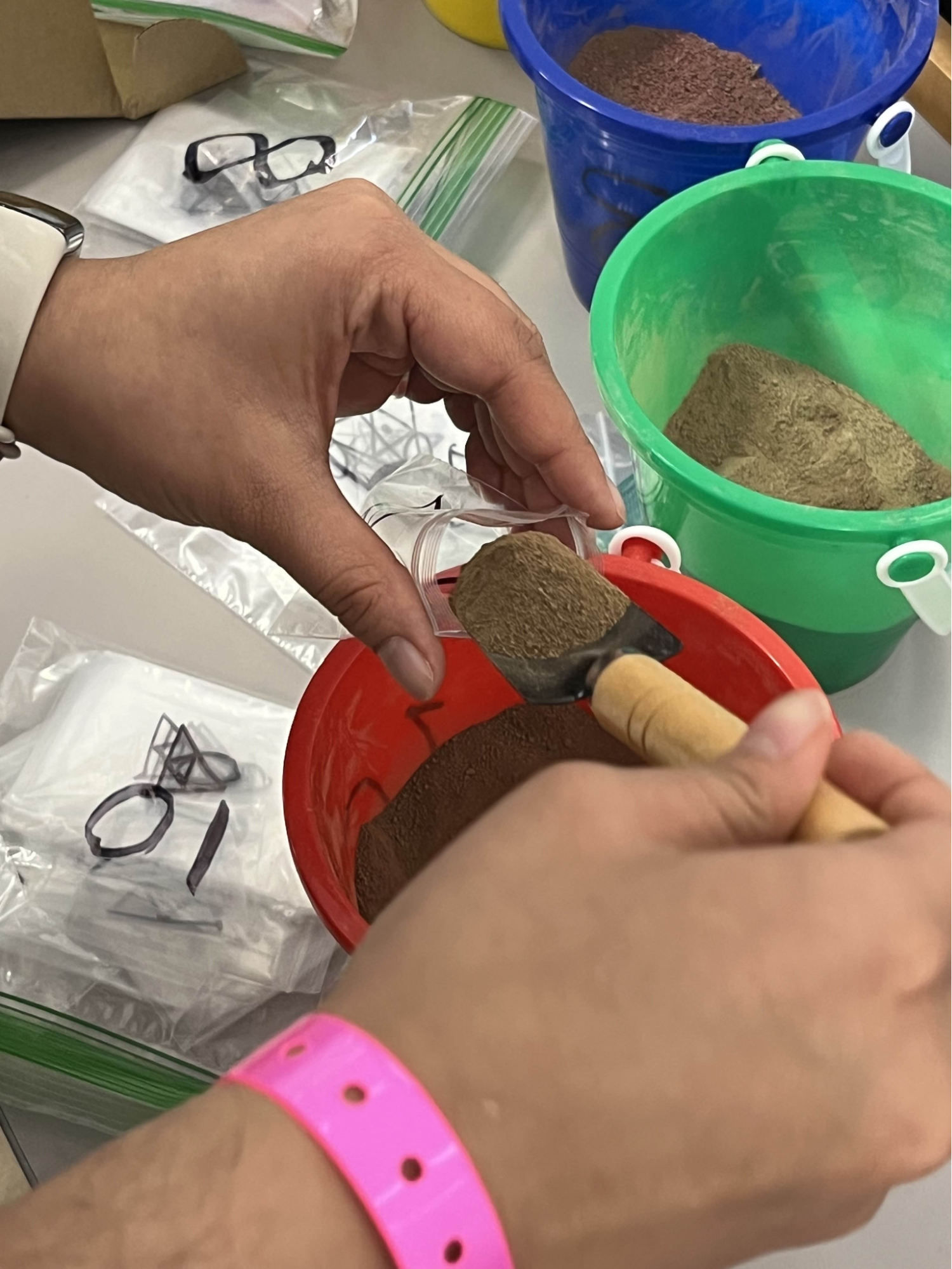
Dirt was conceived when we decided that all puzzles in the Physical Sciences round should be physical. Thomas, in trying to prove how easy it was to come up with a physical puzzle, looked at the answer and suggested giving teams samples of dirt and making them match locations on the Brown University campus.
The same week, when we met with our University administrators to talk about security requirements, they advised that teams not be made to do strange or suspicious behaviors. Without any prompting, they gave the example that people unaffiliated with the University should not go around digging holes around campus.
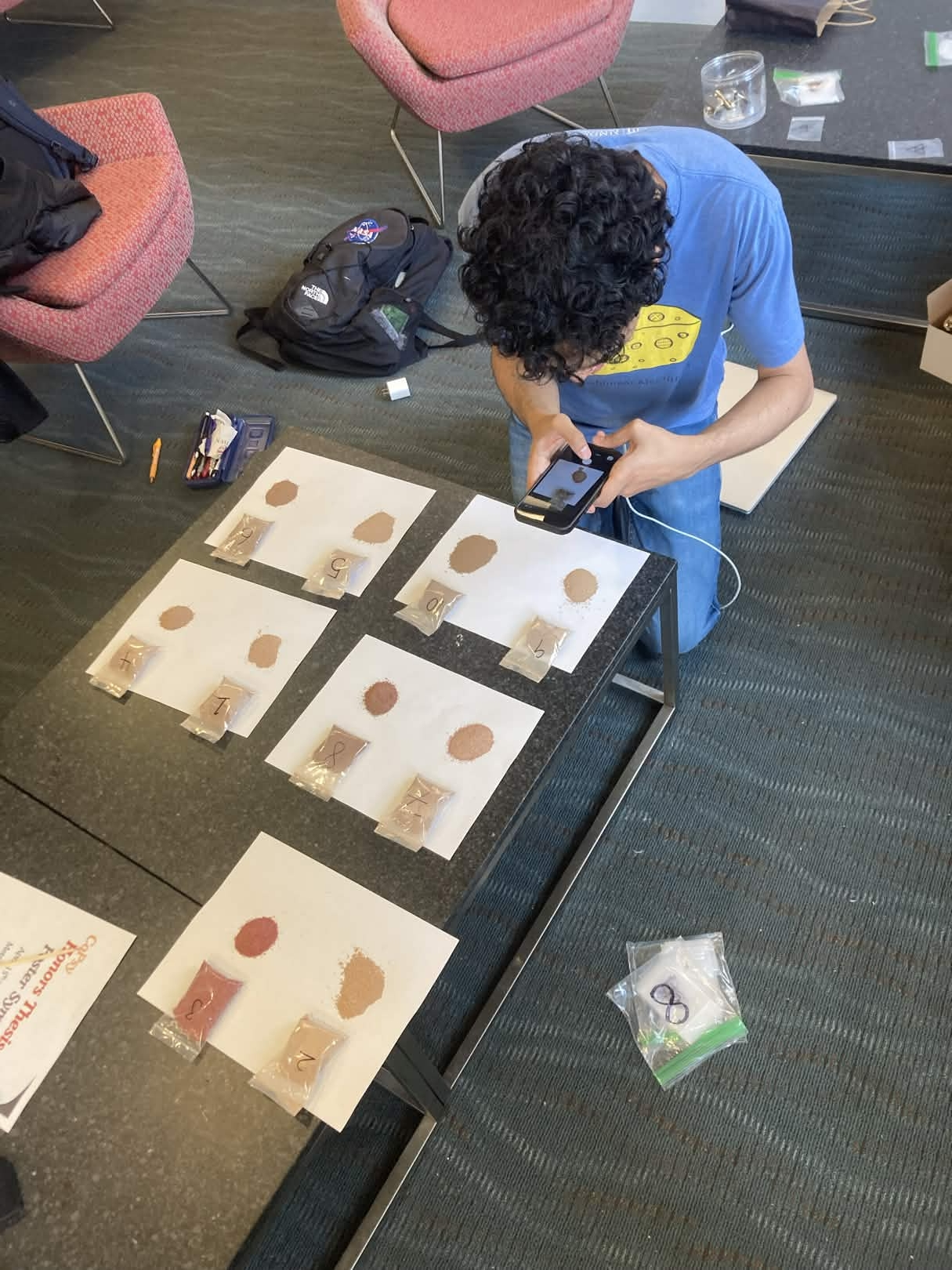
Needless to say, we had to do some rethinking. We landed on wanting teams to locate samples of dirt on the clay-silt-sand triangle. Some of us were extremely enthused about this idea, and some were skeptical that it would be doable by teams with no tools or experience. We consulted our geology friends, and after getting told it probably wouldn’t work, scoured the internet for clay, silt, and sand. Clay and sand were readily available, but finding a place that would sell pure silt was nigh impossible. We settled on buying silt loam from Utah State University, hoping that the dark color of the silt would be different enough from the clay. To the haters’ surprise, testsolving teams were able to successfully place the dirt samples on the triangle, and the enthusiasts won yet again.
Rabbit ‘Nundrum
This puzzle was conceived as “I want to give solvers plushies to play with,” and it became so much more, generating a lovely wrapup heckle, several fan content, and (as far as we could tell) an argument between members of a solving team.
But let’s back up a little. The first draft of this puzzle utilized a mechanic that I’m frankly very happy with, but did not work well with the physical setup, and was too difficult for this hunt. Unfortunately, this only came out during our first test, after I had spent a lot of time on a draft. Very well, I said, and got to rewriting, which took about 25 hours of my spring break. Though writing this puzzle kind of killed me, I learned a lot about what makes for a fun construction.
Here is how it worked: we gave solvers six colored rabbits with letters on them, six instruction sheets, and a plastic top hat (latter two not pictured).
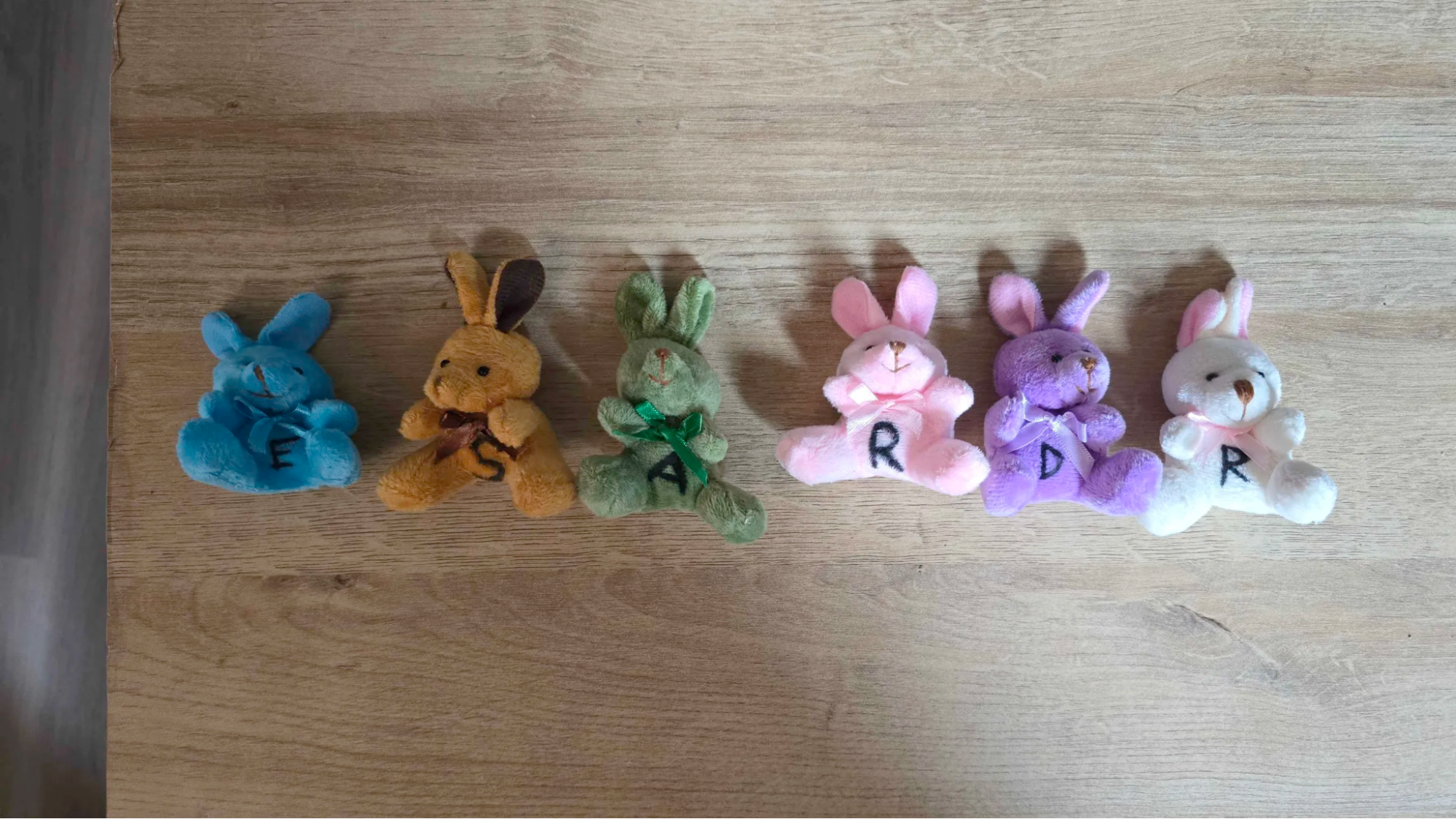
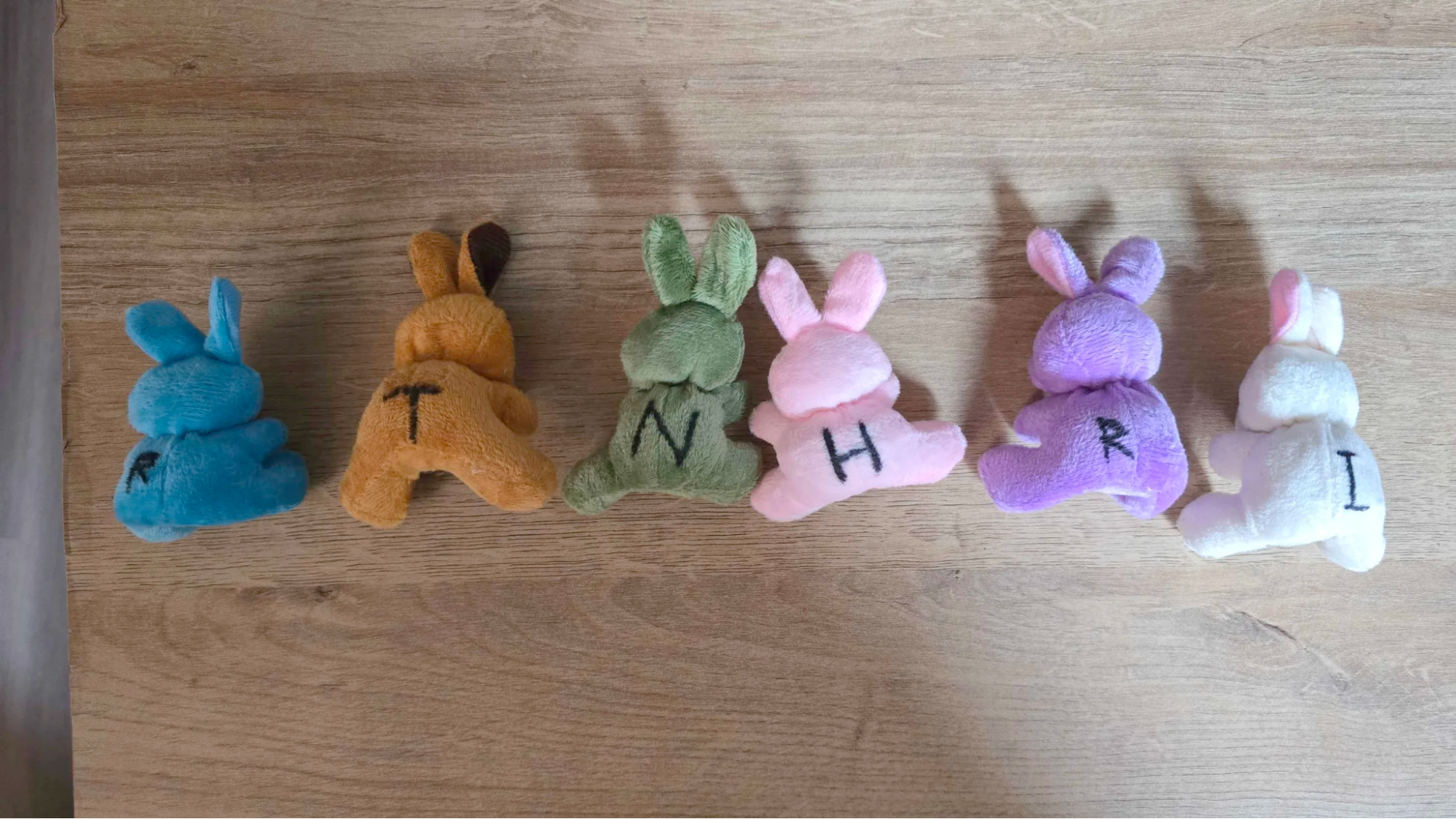
The puzzle is meant to be solved with six players, each of them taking charge of one of the rabbits — crucially, text on the puzzle page instructs solvers not to peek at each other’s instruction sheets. This mechanic was inspired by The Nomenclept, a puzzle Thomas wrote for BPH 2024, and I think it worked well with how this puzzle split up responsibility among the various roles. For example, there is one rabbit whose instructions detail how to count “steps,” and another rabbit who spikes the tea with psychedelics and makes every other rabbit see colors differently (which must be figured out by consulting a table on that rabbit’s instructions sheet). All of this must of course be communicated between solvers, which I hope was fun.
After working through all of the instructions followed in the konundrum part of the puzzle, solvers obtain the phrase INSIDE HATTER. Submitting this yields the partial answer confirmation: “Do what must be done.” Indeed, the other main conceit of this puzzle was that solvers had to cut open one of the rabbits to access a hidden message!
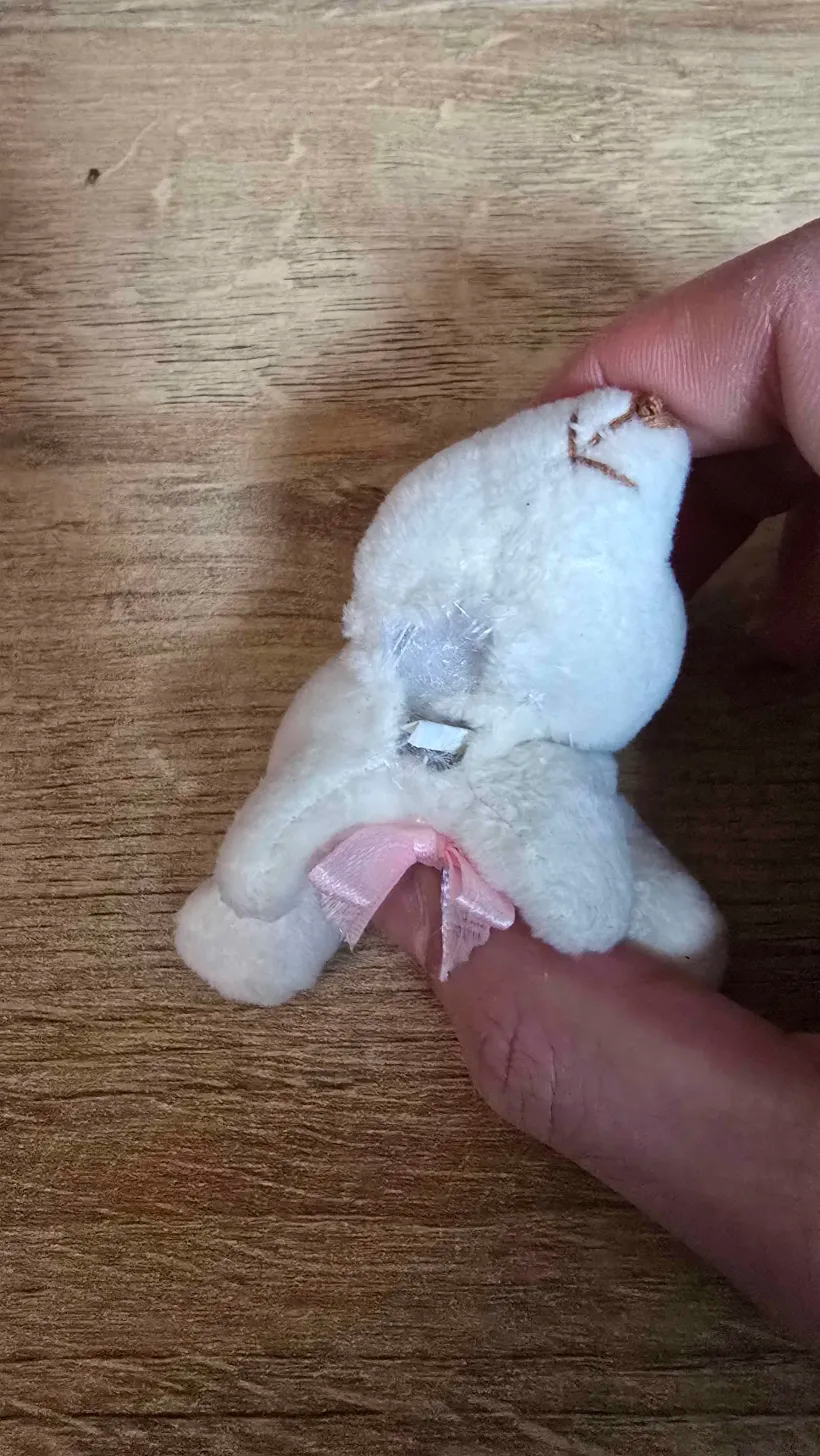
I was heckled at wrapup for this (“psychopath!”), and received two pieces of fan work:
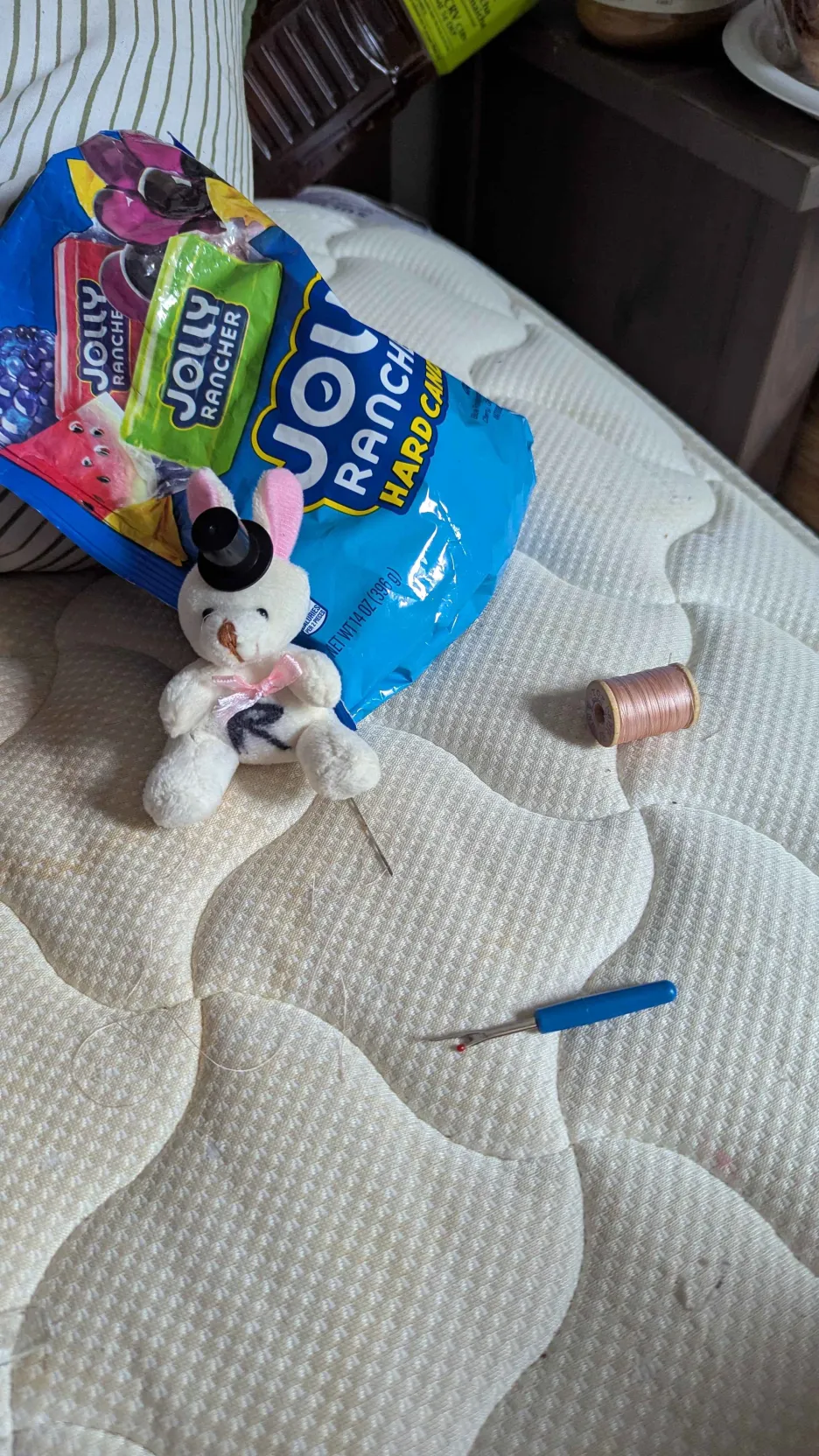
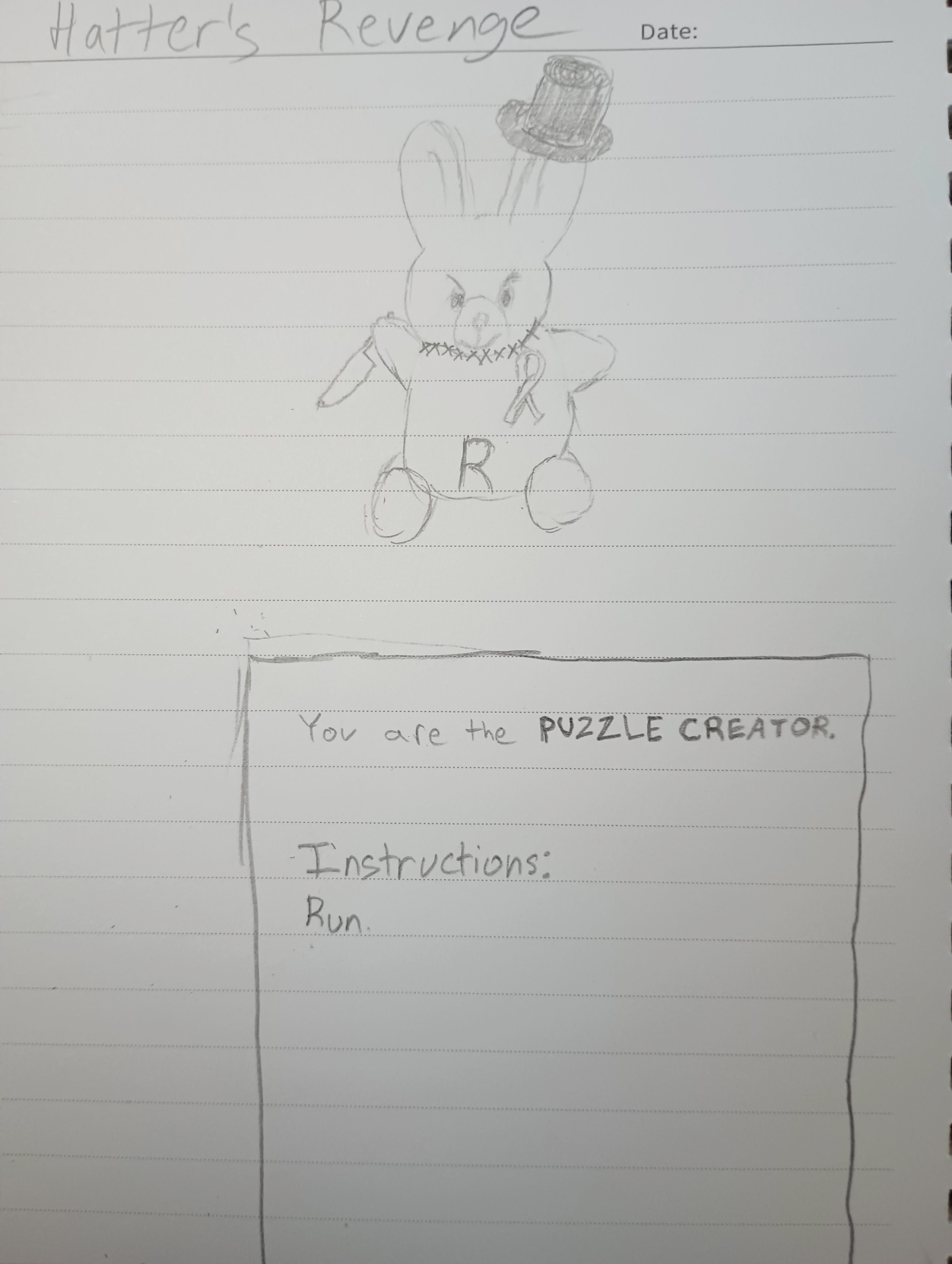
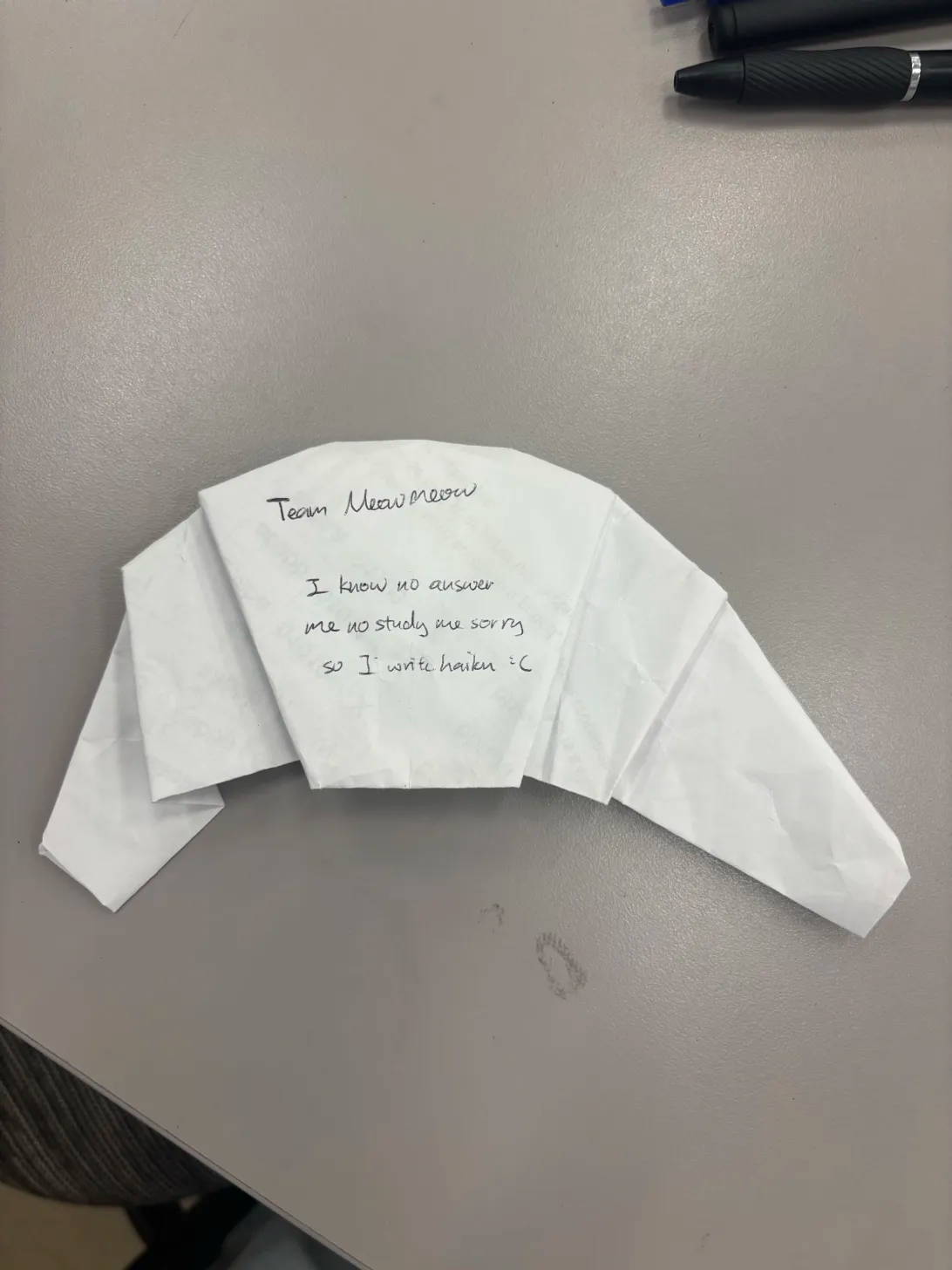
Thank you to Isaac and Hatter for these lovely contributions to the revival of The Hatter. There was a team who refused to cut open the rabbit’s head, and backsolved the puzzle despite having forward solved all of it; props to team meowmeow for keeping The Hatter alive. Finally, our apologies go out to the anonymous team who filled out the feedback form and seems to have had an argument with their team over this puzzle.
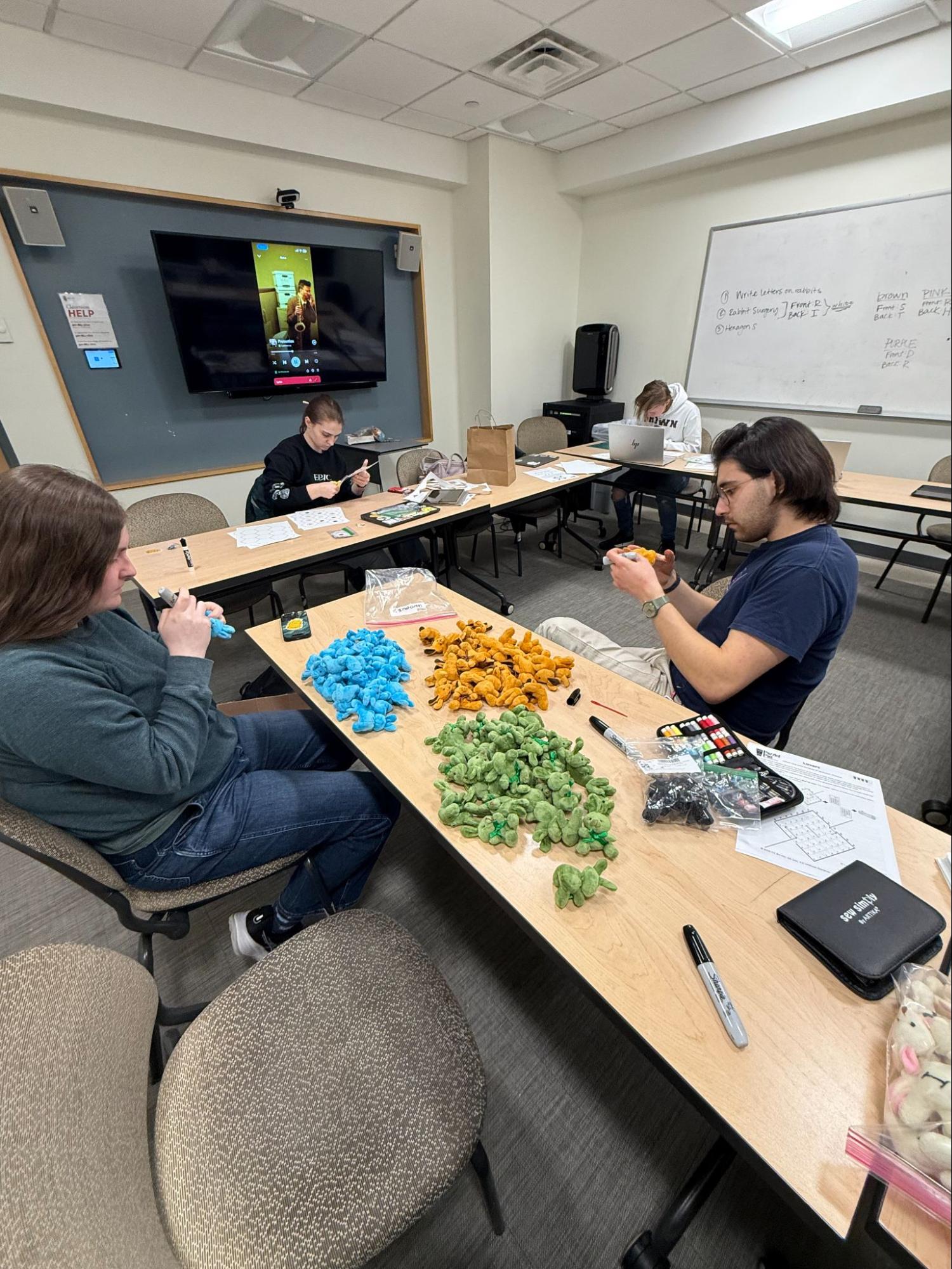
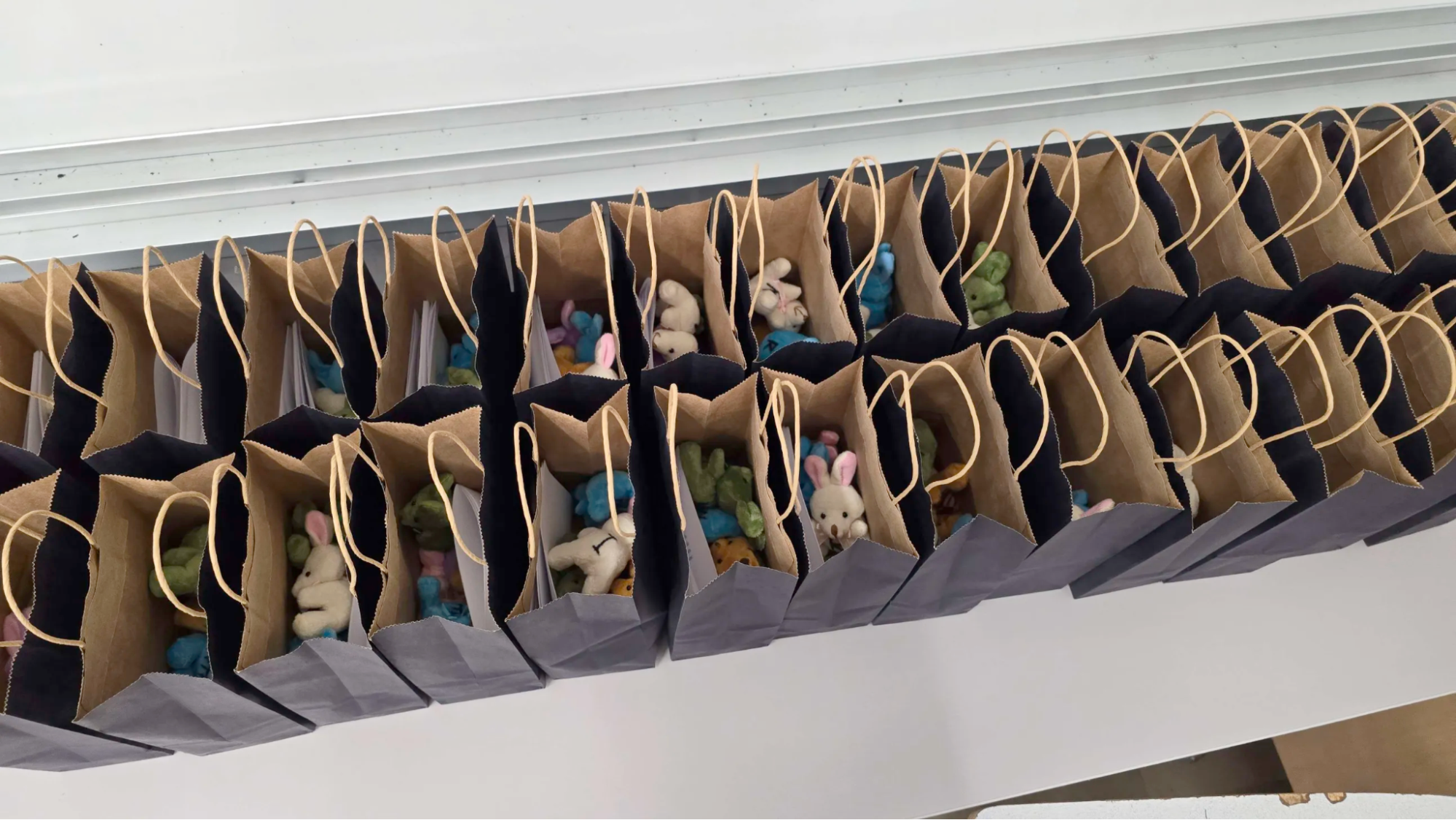
If you’re wondering what preparation looked like, here is a massive pile of rabbits in the process of having letters put on them:
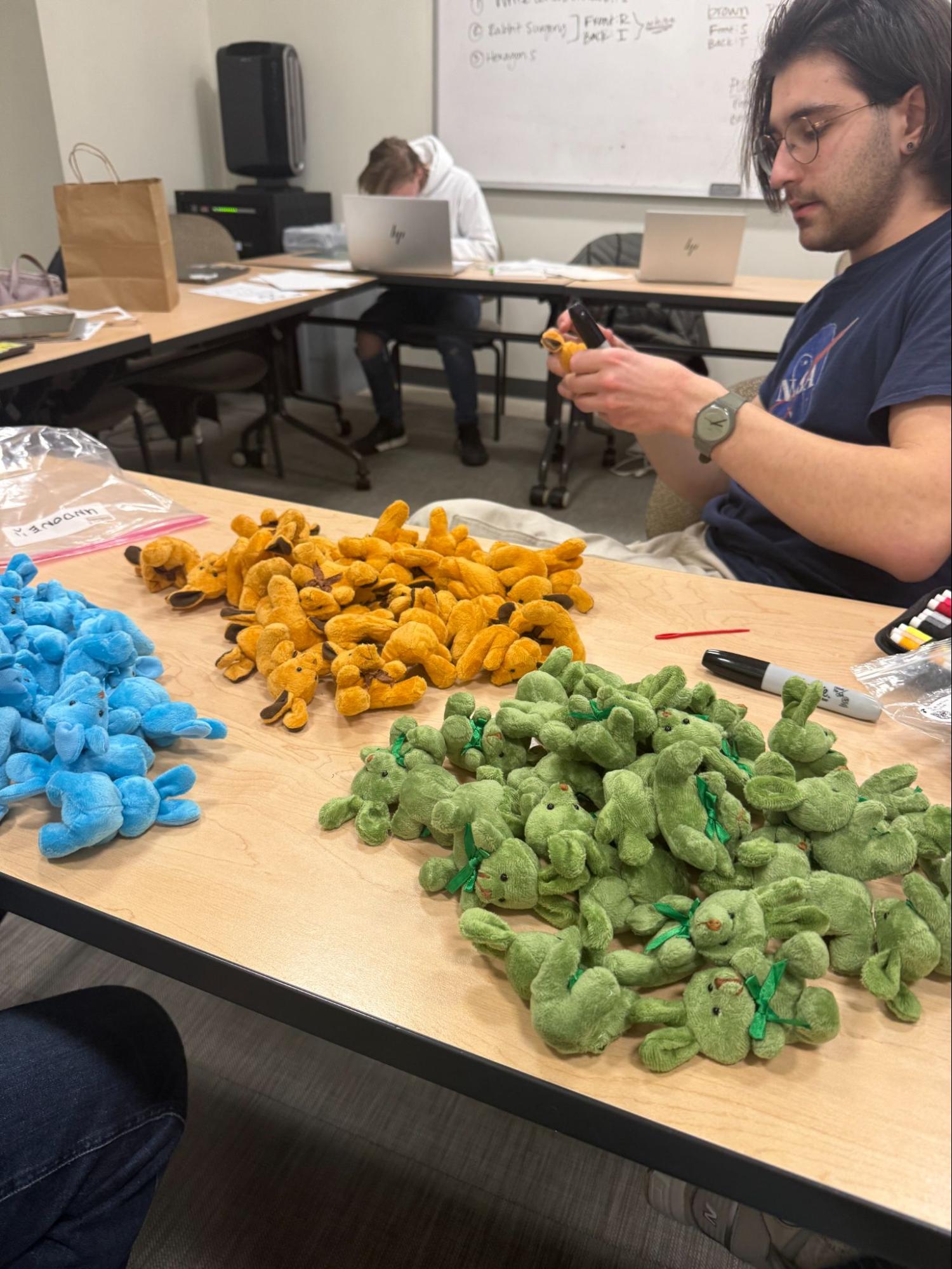
We initially thought we were going to have to cut open the white rabbits and sew them back up, but it turns out the holes between the stitching on the back of their neck are large enough to slip the piece of paper between. The benefits of using cheap plushies!
Linesman Training
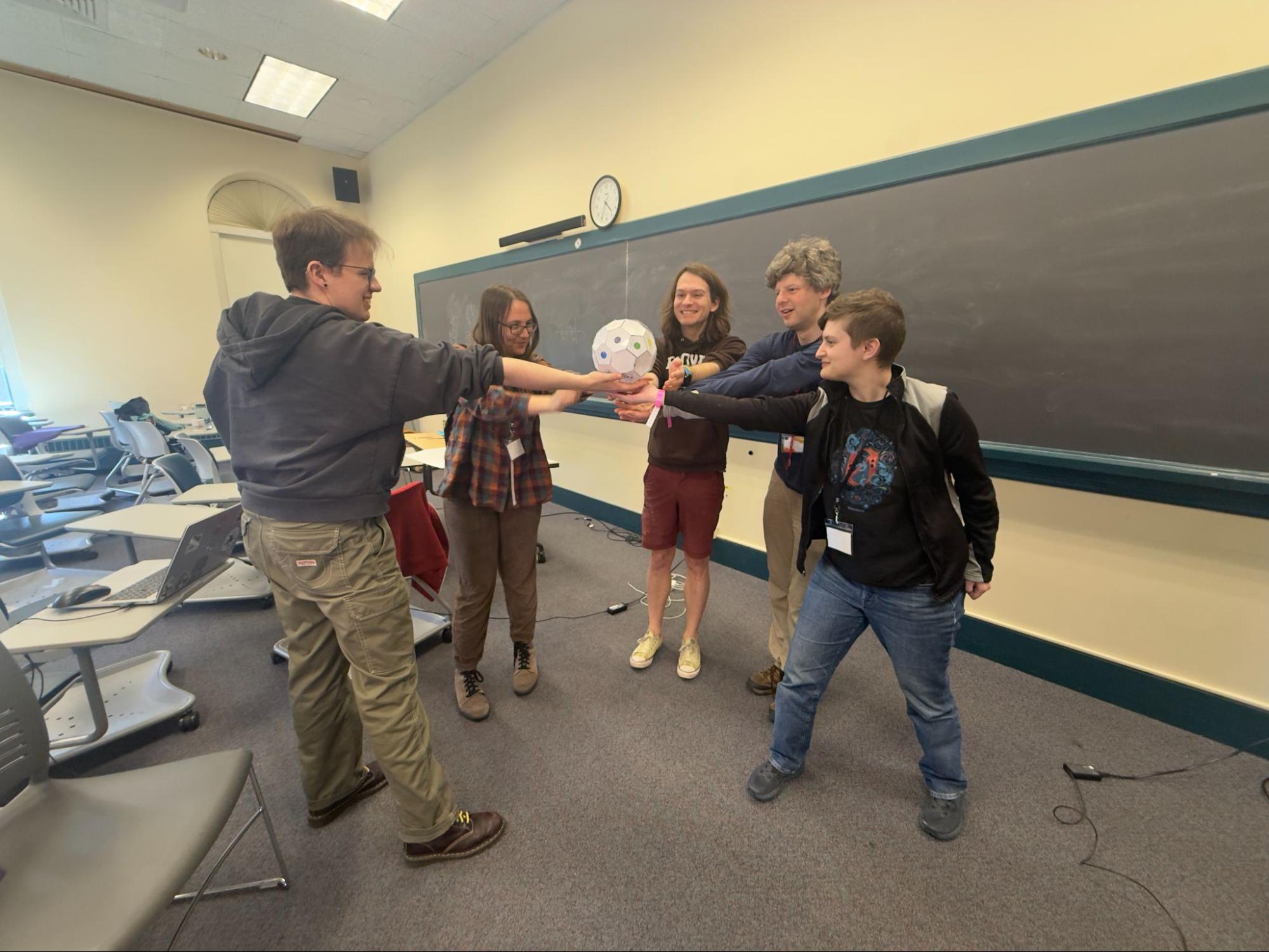
Linesman Training was another physical puzzle that came about because of our desire to have the Physical Sciences round be entirely physical puzzles. As solvers of this puzzle may recall this puzzle had the answer HELLOBEETIFUL (thank you Rae Dunn and spaghetti) which for unknown reasons was one of the feeder answers that wasn’t claimed for a while. Due to the word “bee” in the answer and the desire to make this a physical puzzle, we decided to have this puzzle in some way be soccer ball themed (due to the hexagons in a standard soccer ball net and the possibility of getting solvers to in some way interact with a physical soccerball). It was only once the puzzle had been almost completely written when we discovered that “beetiful” was not a play on the word “bee” but on the word “beet”.
When writing this puzzle, we were really inspired by the idea of forcing the solvers to really interact with the full physicality of the ball. Although we failed in this endeavor (I’m still very impressed with the people that solved the puzzle without putting the ball together) we did get pretty close by using semaphore on the surface of the ball. This let us extract using the angles between the tiles—a piece of information only available in the constructed ball and not the net.
Then we had to figure out how to get the teams to construct the balls. We thought it would be cool if we could put words on the pentagons and have the letters on each of the surrounding hexagons spell out the word. After trying to come up with a set of letters and words by hand (we were only able to come up with 4 of the required 12 pentagon words before the letters became so constrained that no fifth word existed) we realized that this construction was more challenging than we realized. Our solution to this was to code something to check for valid letter and word combinations. Only after running a python script that searched for words that fit these constraints for around 48 hours using over 2 TB of memory on Oscar (Brown’s Supercomputer) and getting only a handful of possible combinations did we realize just how constrained this construction really was. Every possible combinations included some incredibly questionable words (the list we picked was the best one, and it included “Chups”, “Kovar”, and “Frady”; for reference on how constrained these words were, our first list, which we celebrated immensely over when found by Oscar, included “Admrx”, “Bejig”, and “Nugmw”). (We changed the corpuses we used after that…) Because of these words, we decided to replace them with crossword clues on the pentagons so that solvers would arrive at the words themselves, hopefully making them seem more legit. This combined with some notches to prevent a full reflection of the ball during the construction and also to preserve the orientation of a few key pieces fully determined the ball’s construction.
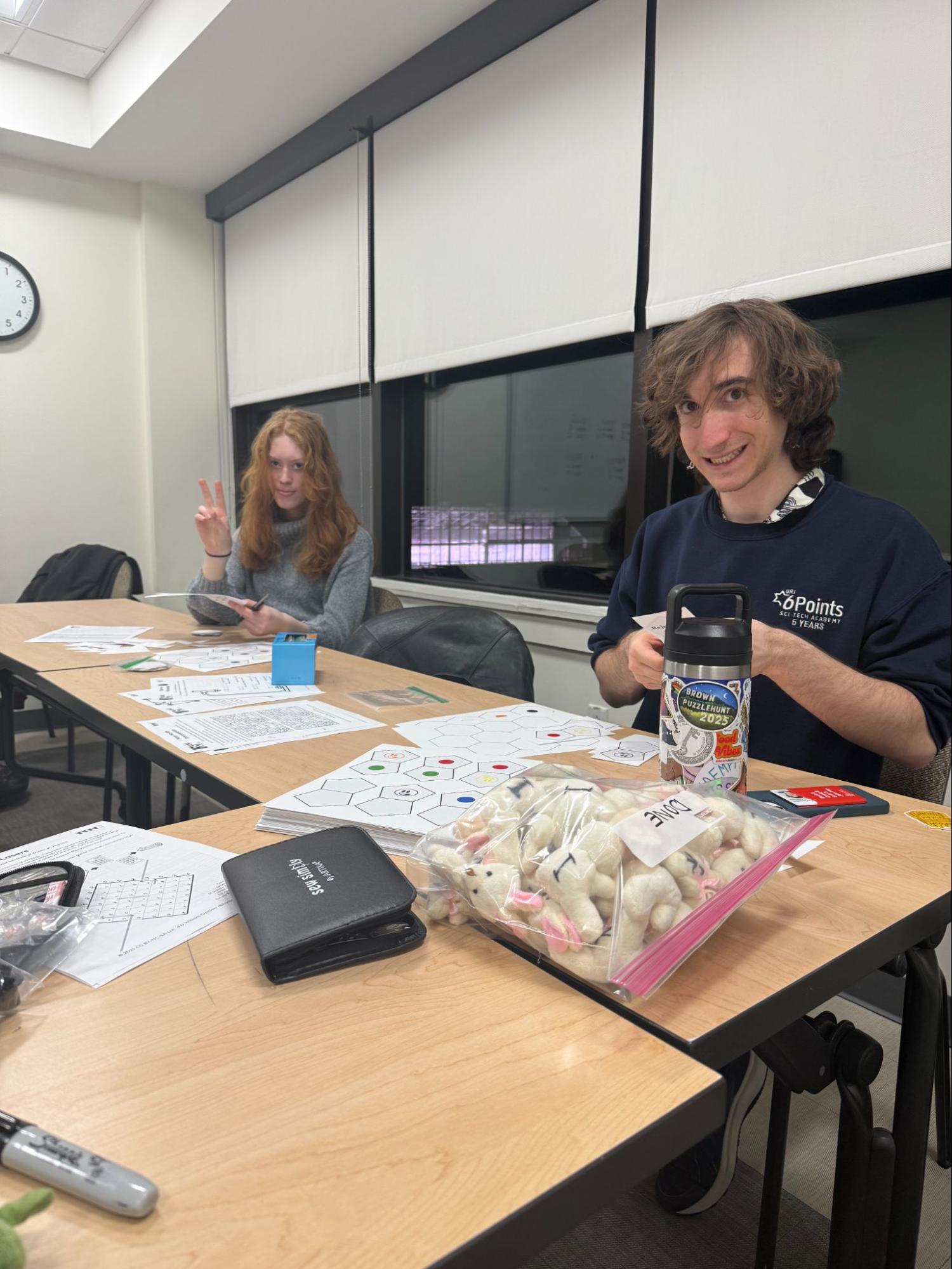
The final part of this puzzle was preparing it. Since it was an opening puzzle, we needed to have a copy for every team that we had registered (which meant we had to create at least 40 copies of the puzzle—we ended up making 50 copies to be safe). Since the puzzle involved constructing a soccer ball, each copy needed a specific 12 pentagons and 20 hexagons printed out on cardstock. Additionally, since I thought it would be more fun for solvers if they didn’t have to cut out the pieces themselves, we decided to cut out every piece. At 32 pieces a copy and 50 copies, we needed to cut out 1,600 total pieces of cardstock (all either hexagons or pentagons). Since the usual cutting time for a single copy was around 15 minutes (the fastest was 9 minutes and 30 seconds with the good scissors) we estimated about 12.5 person-hours of construction time for this puzzle. And despite all of this, we still somehow failed to make the most annoying physical puzzle to construct. I guess there’s always next year…
Events
By Aren GuralpSpeed Shopping
Please send 2 students that work well together. Speed will be of the essence.
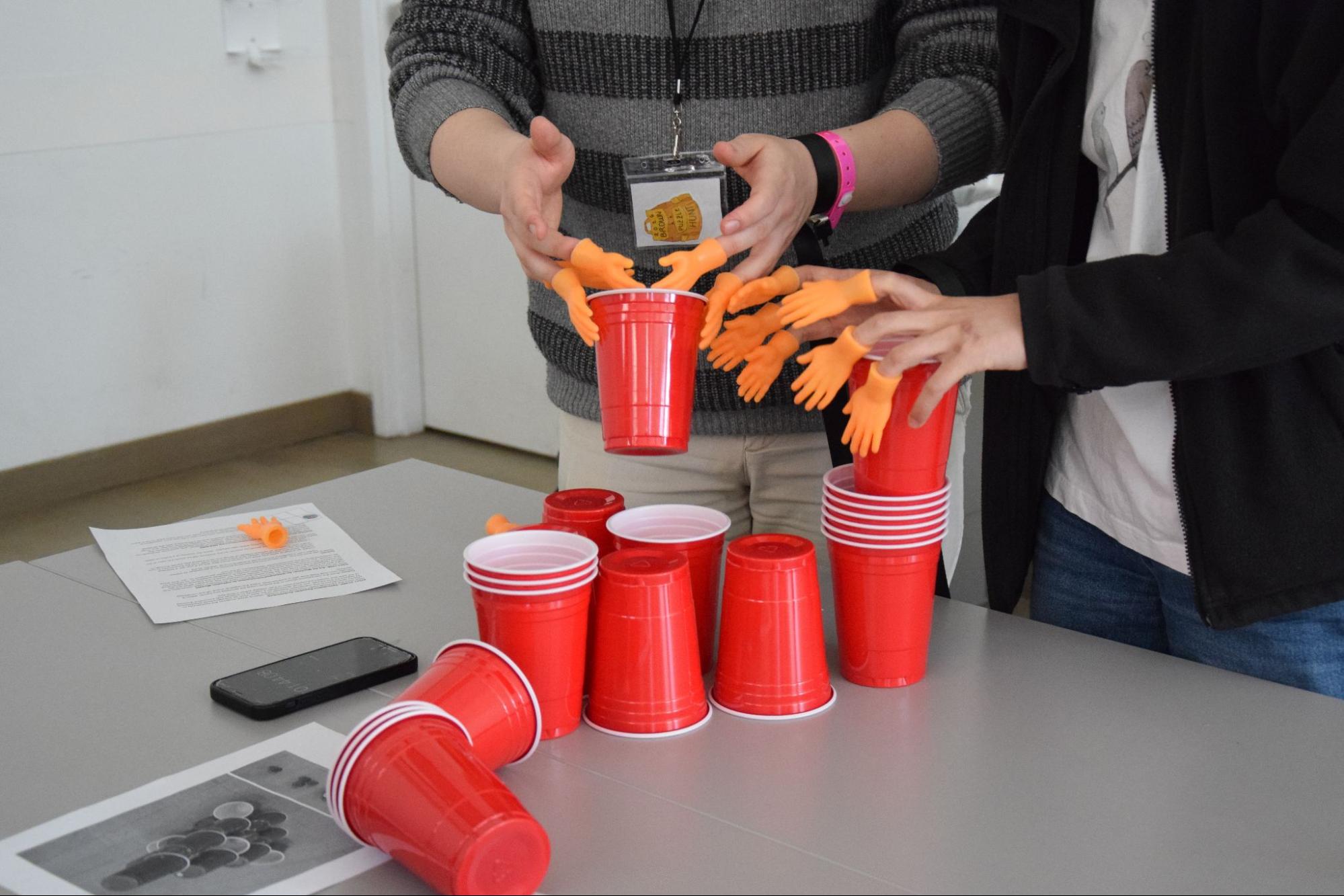
This event involved teams of two students being handcuffed together (using “adult leashes”) and completing a series of activities in order to register for the classes they wanted to take.
These classes were:
- EGYT 0150X: Speculative Egyptian Architecture
- CSCI 1499: Art As Machine: An Integrated Introduction to Diffusion Models
- PHOTO 5317-01: SHADOWS: DECONSTRUCTED DREAMS
- CHEM 0380: Organic Chemistry III
- Pitch an Independent Research Project!
Each of them required the completion of a different activity in order to receive an override code, in order:
- Build a cup pyramid using tiny hands
- Draw a course title as if you were AI, then chug a small water bottle
- Recreate pictures of shadows puppets
- Invent a molecule to be a new pharmaceutical, and explain how it works
- Pitch a research project using or relating to at least two of the objects in the room, within 1 minute.
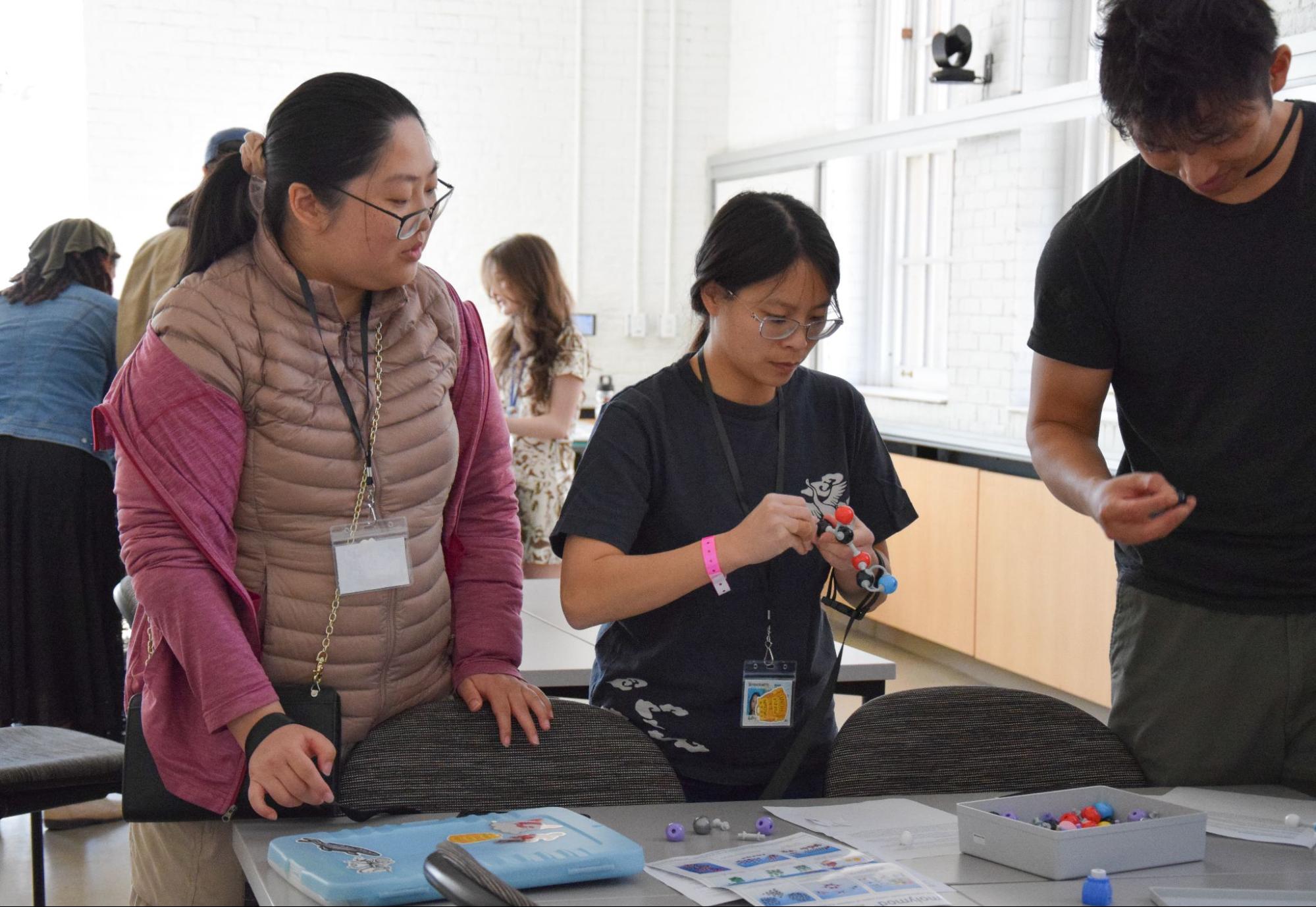
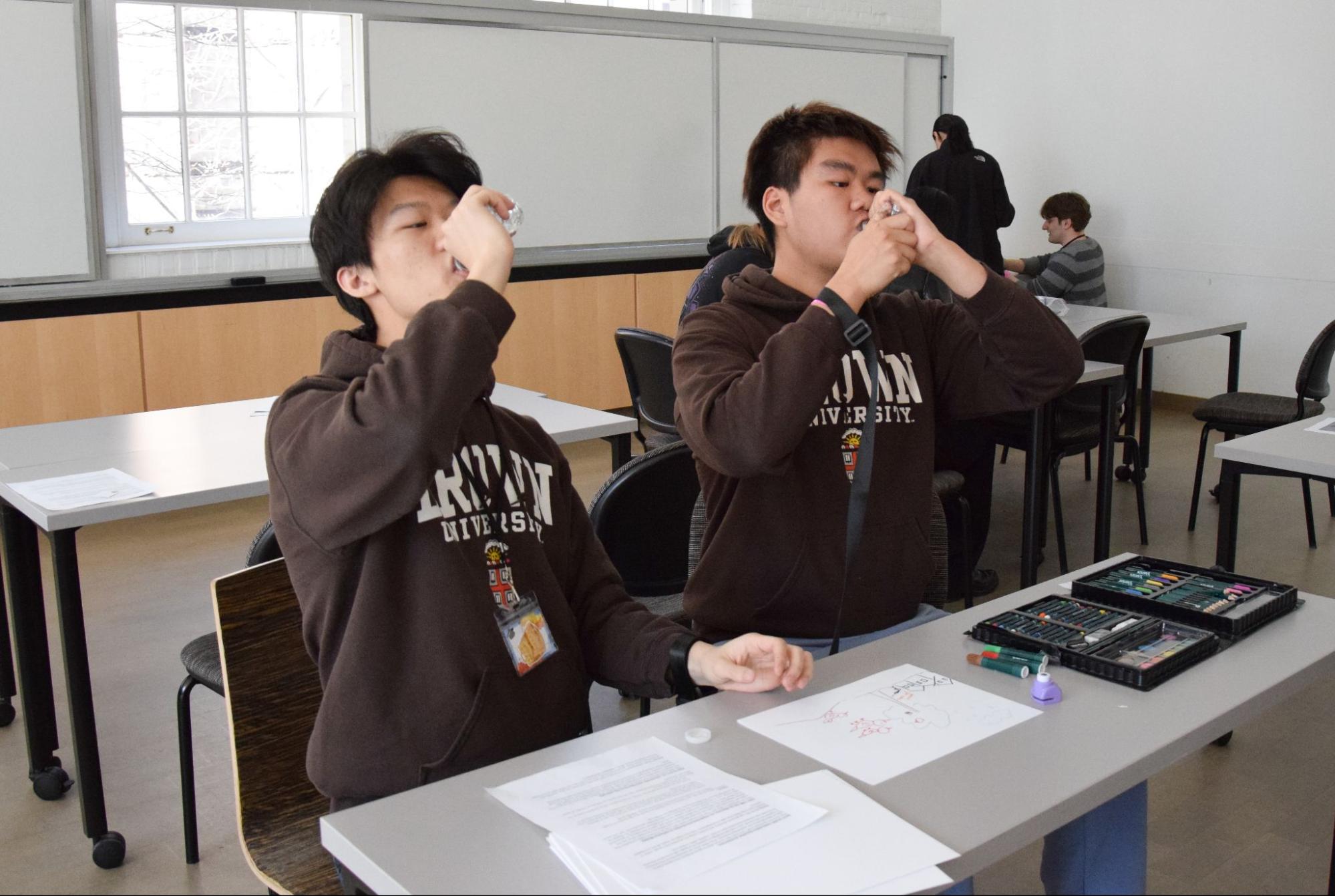
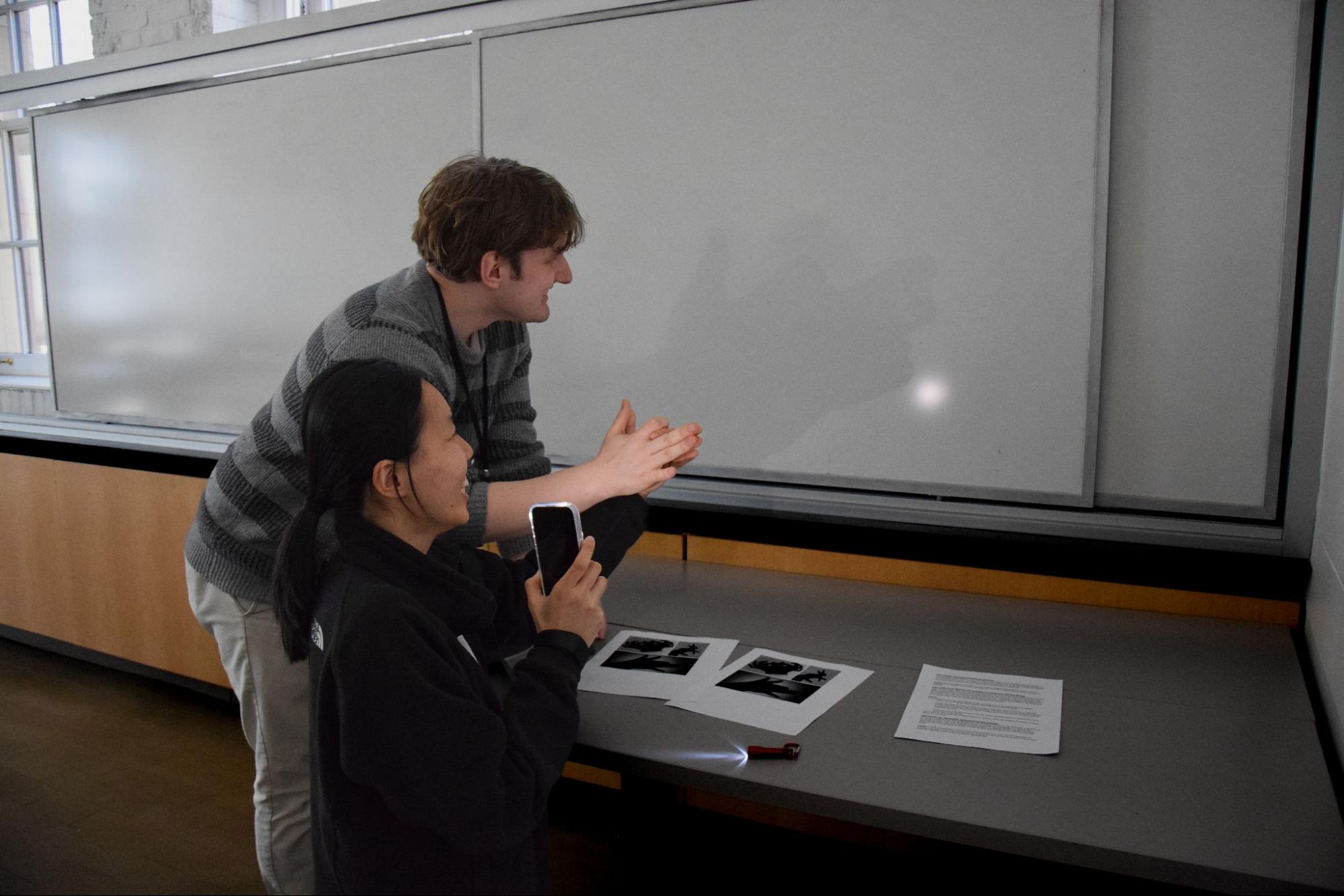
And, finally, here is a photo of Noah testing the “leashes” out on Thomas:
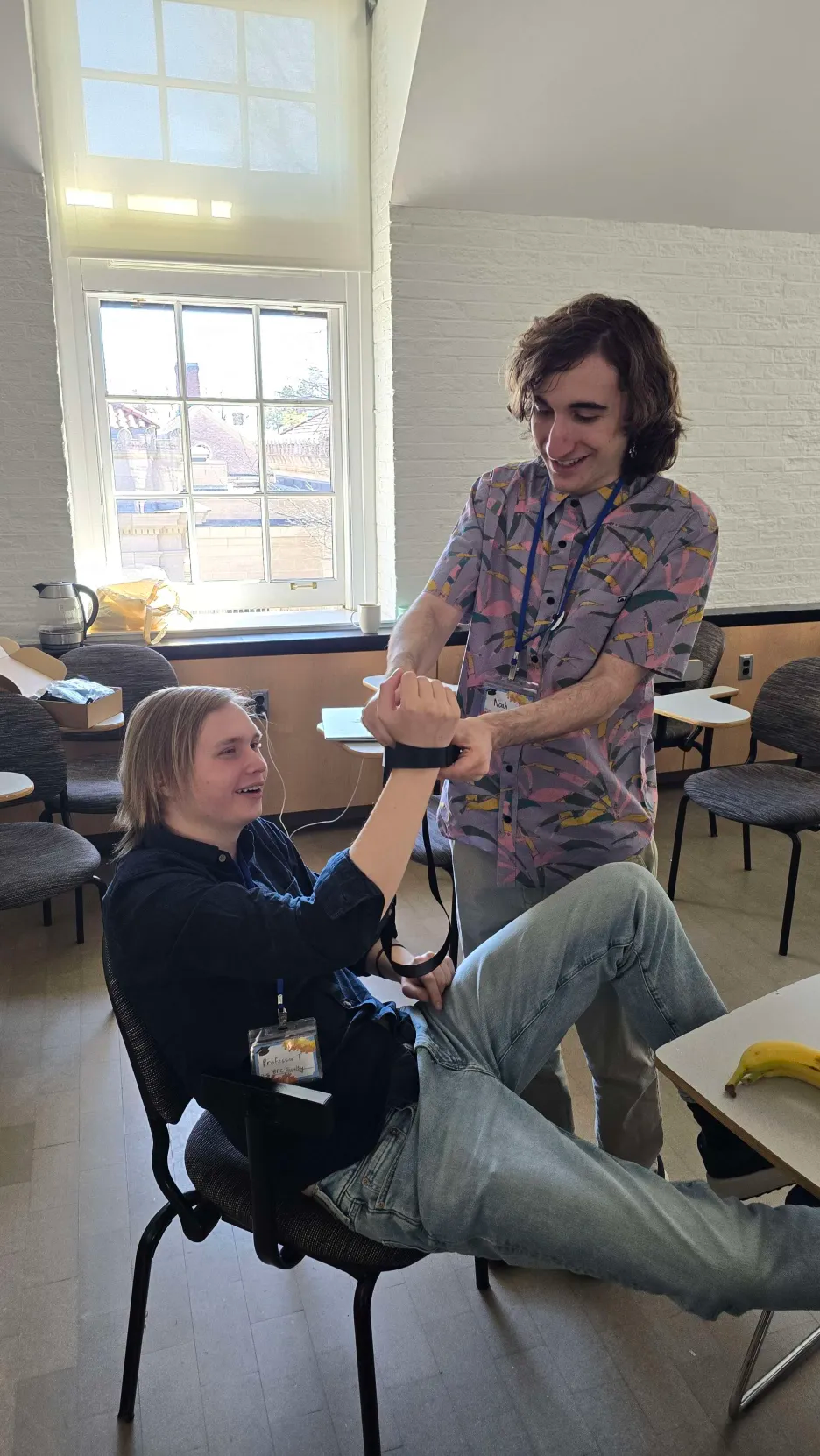
The answer for this event was RACING CARTS.
Thank you to:
- Bailey, Noah, Annie, Nate, Nicholas, and Jack for helping run the rooms, and Megan and Arnav for watching the door;
- Philip and Nate for designing the cup pyramid, and to Philip for finding shadow puppets and interesting courses to draw; and
- Julia for the wonderful pictures!
Thesis Defense
Please send 2 students skilled at constrained communication. The ability to improvise under pressure will be crucial.
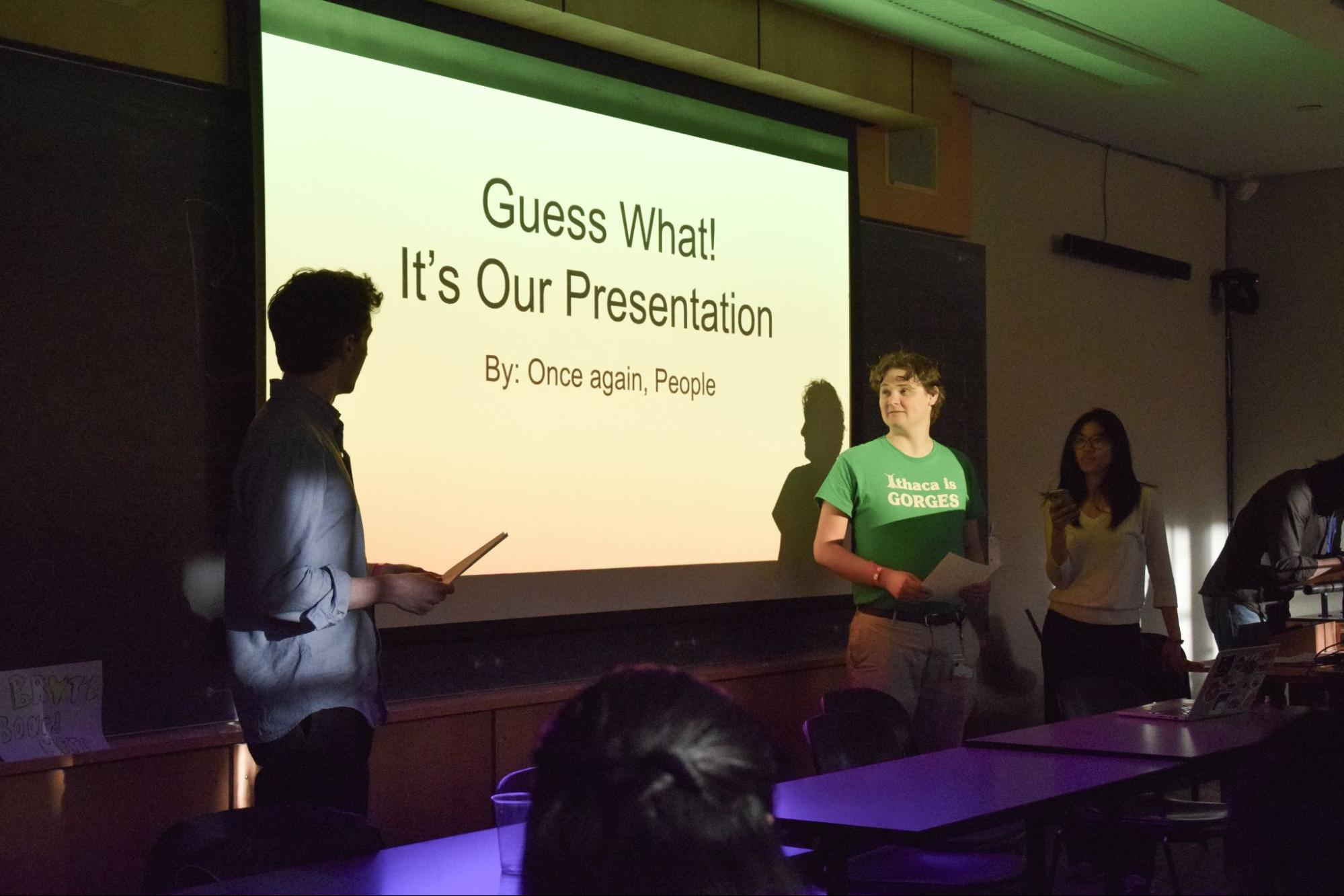
For this event, students had to give a thesis defense — unfortunately, they spent all night working on their slides, and forgot what they put on them! Each pair of students were given a slide show and a card that told them their topic and a list of words they were not allowed to use. They had to present this in two minutes, with a minute at the end for questions from the audience; their goal was to successfully guess the topic of the presentation.
The catch? The slide shows were designed to be as unhelpful to their cause as possible. Here is the full list of topics (which we picked a subset out for each group):
- The Water Cycle
- The Pythagorean Theorem
- The Chinese Zodiac
- The French Revolution
- The Steam Engine
- Queen (the band)
- The Mona Lisa
These had such helpful slides accompanying them as a picture of the desert for the water cycle, a plate of sauerkraut and sausage for the French revolution, and the British flag for the Chinese Zodiac. This event turned out a lot easier than we expected, but many solvers took it in stride and played with the format, which we were happy to see.
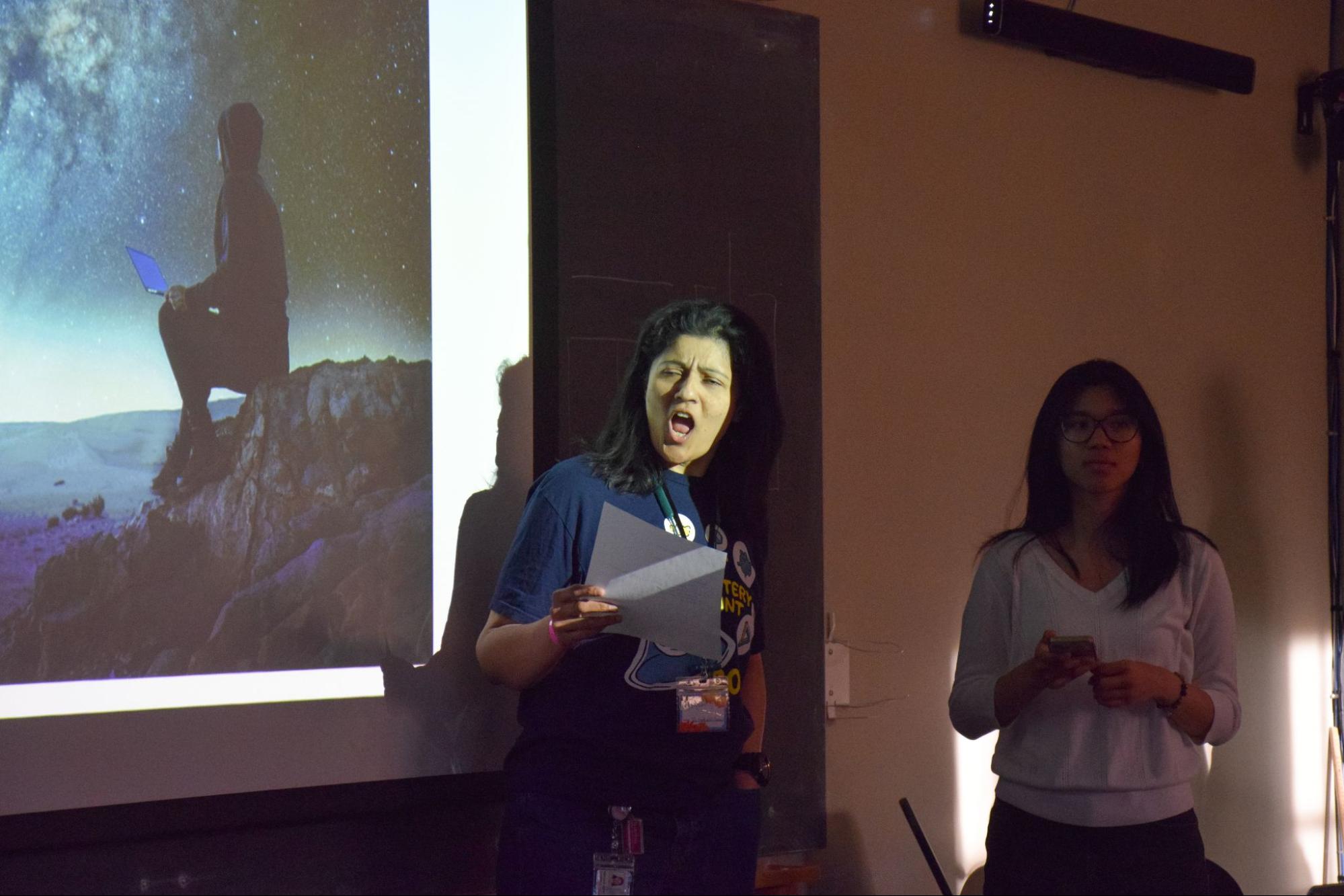
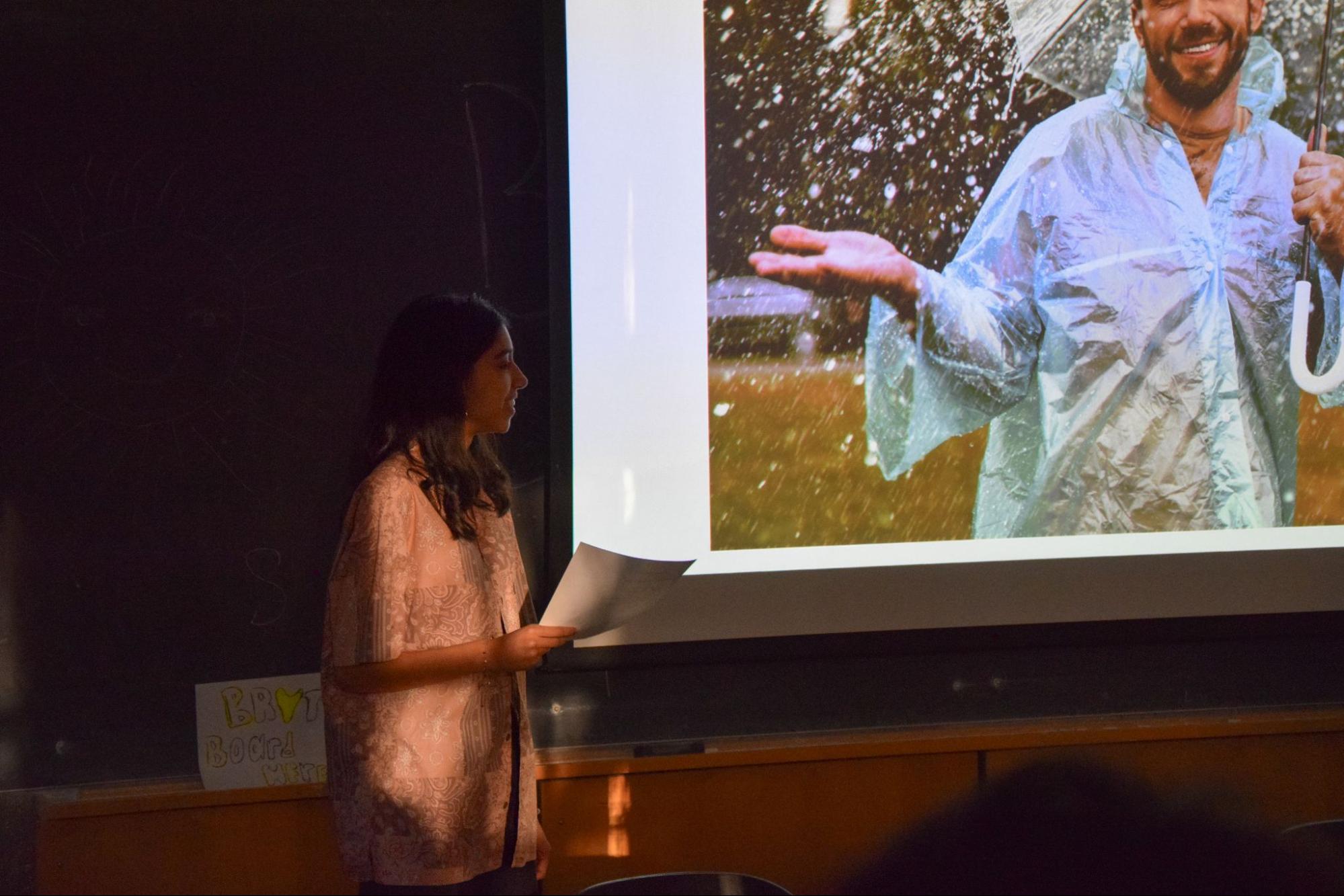
The answer for this event was SPEAK NO TITLE.
Thank you to:
- Sofiya, Murahn, and Thea for helping run the event, and Philip for watching the door;
- Erin for designing the slideshows; and
- Julia for the wonderful pictures!
Collaborative Exam-Taking
Please send 1-2 students with a talent for the clandestine. Creativity and boldness will prove vital.
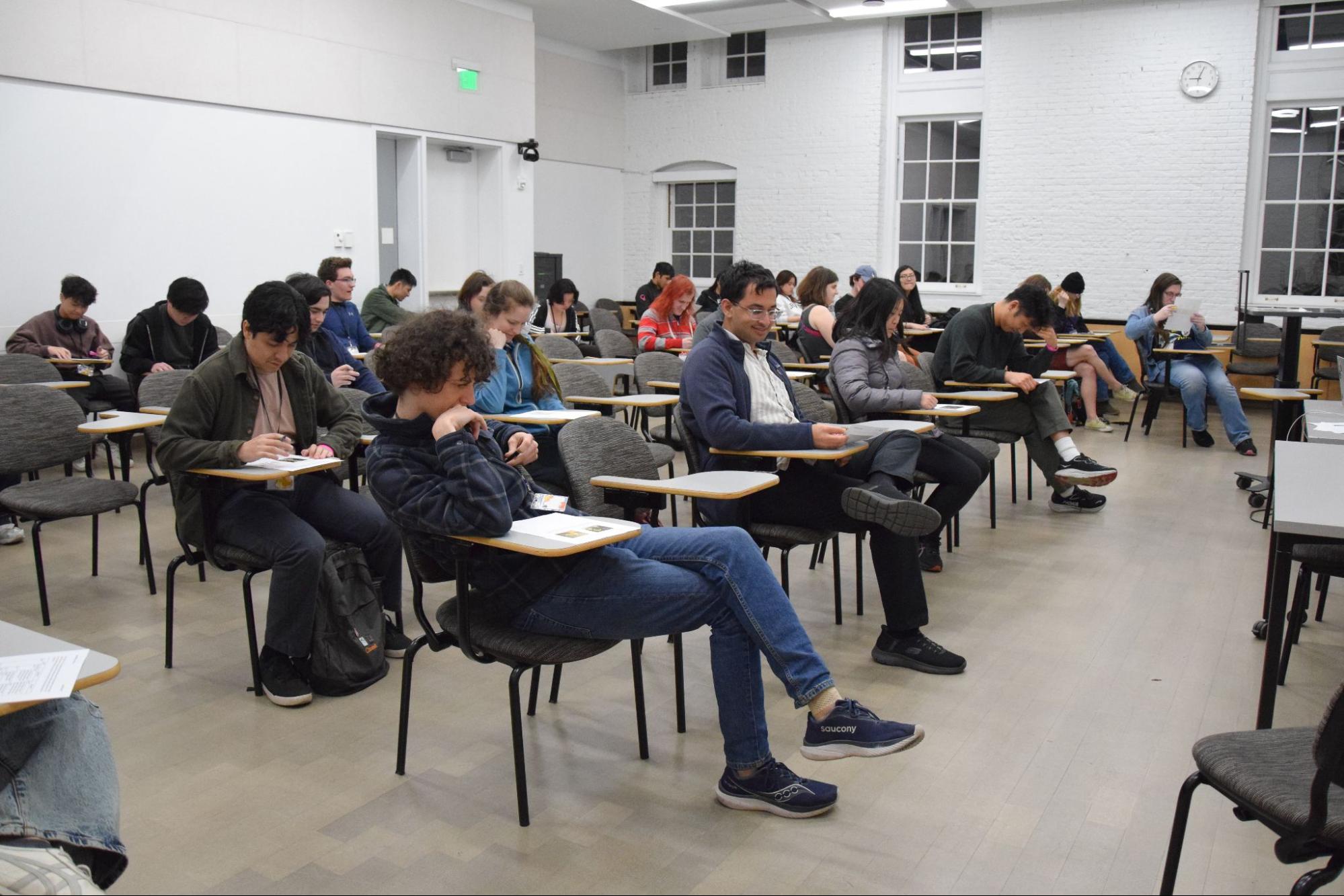
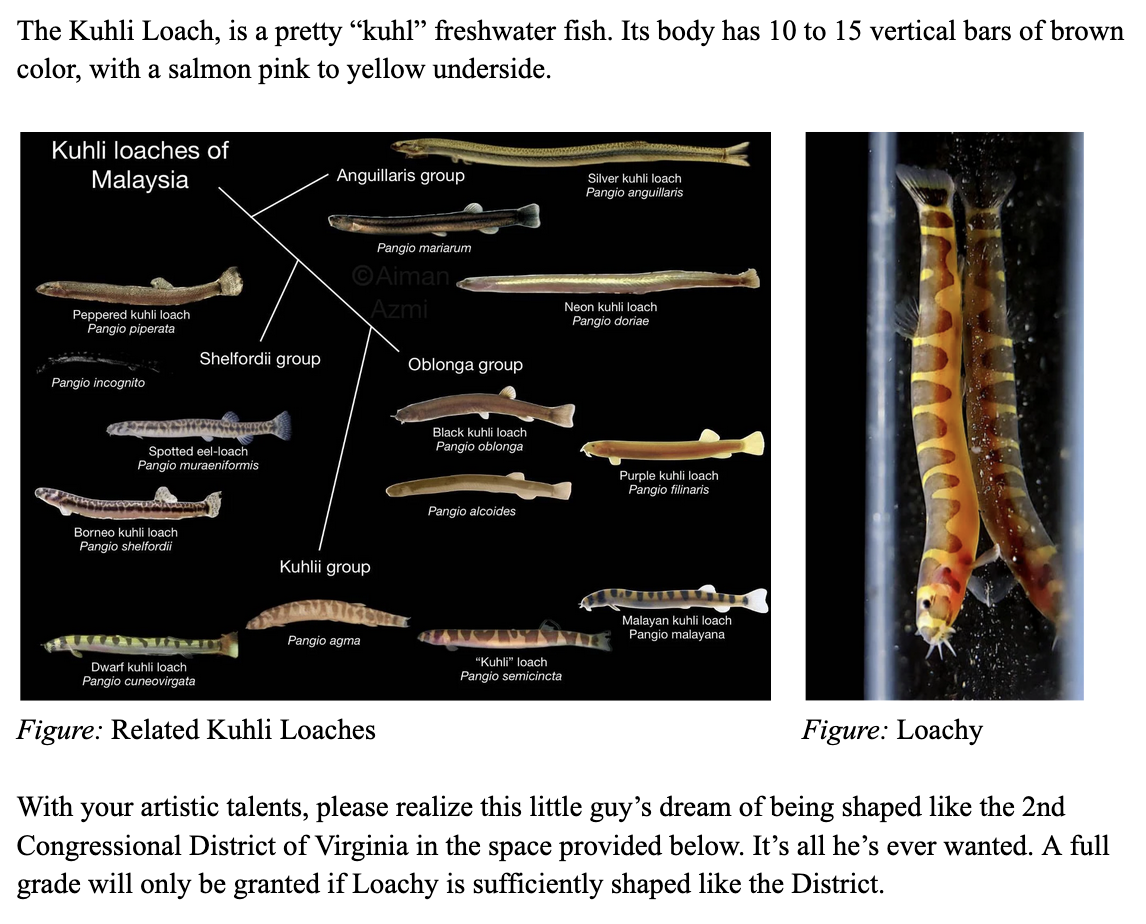
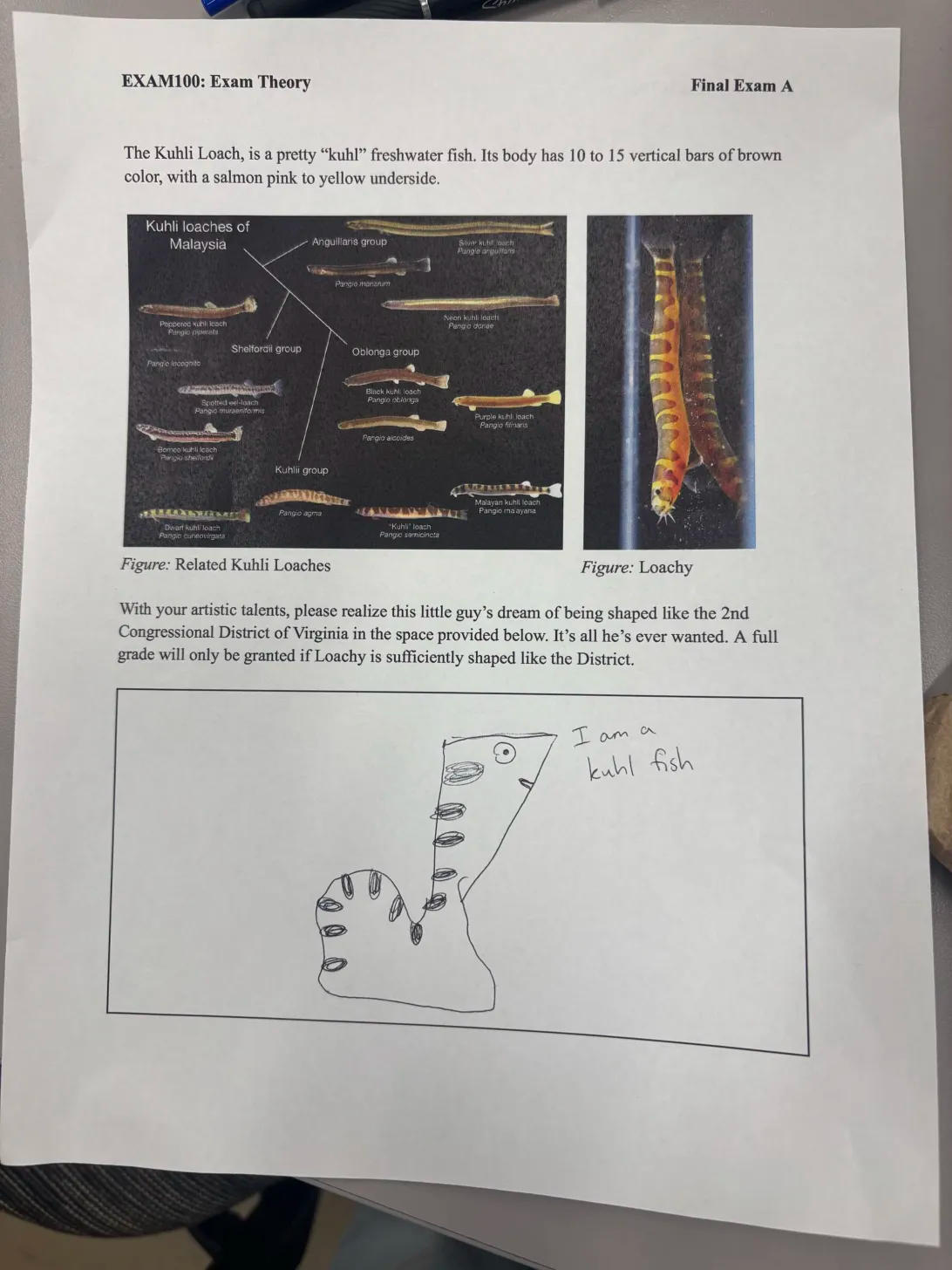
This event was easily the most chaotic. Each student had an exam question that required highly specific information they were unlikely to have, while at the same time providing some highly specific information of its own. Of course, the 2nd Congressional District of Virginia was given on a different exam paper, which asked for an example of a tiling with wallpaper group [∞⁺,2⁺,∞], and so on. There were ten of these, and two versions of the full set to ensure solvers had to be precise about their communication. Moreover, we had several proctors to watch over the room and “ensure” students weren’t cheating.
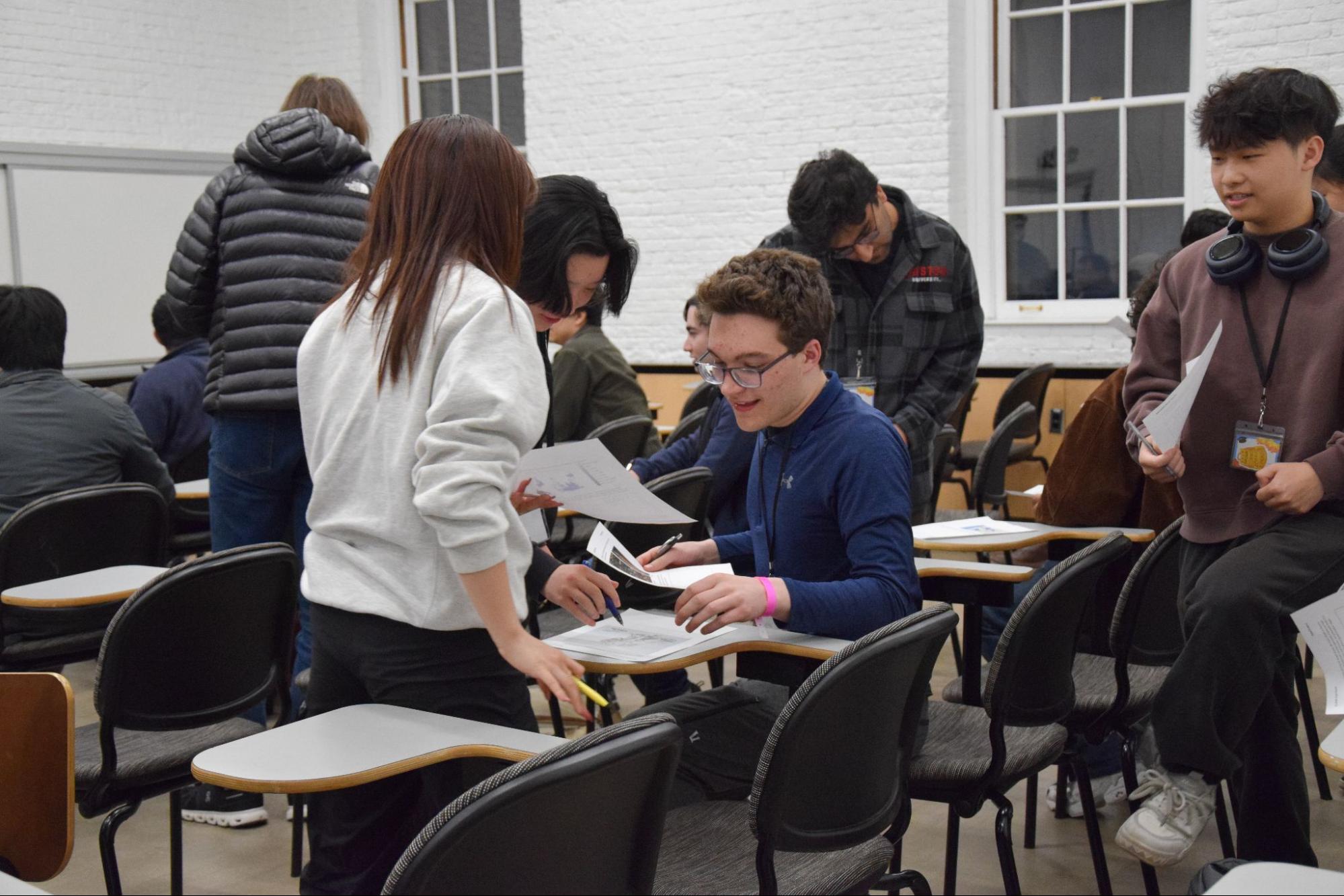
Unfortunately, we underestimated how willing students were to blatantly get up and talk to each other, despite the proctor’s requests to sit back down. Needless to say, this event was demolished within twenty minutes, but it seemed like students had fun!
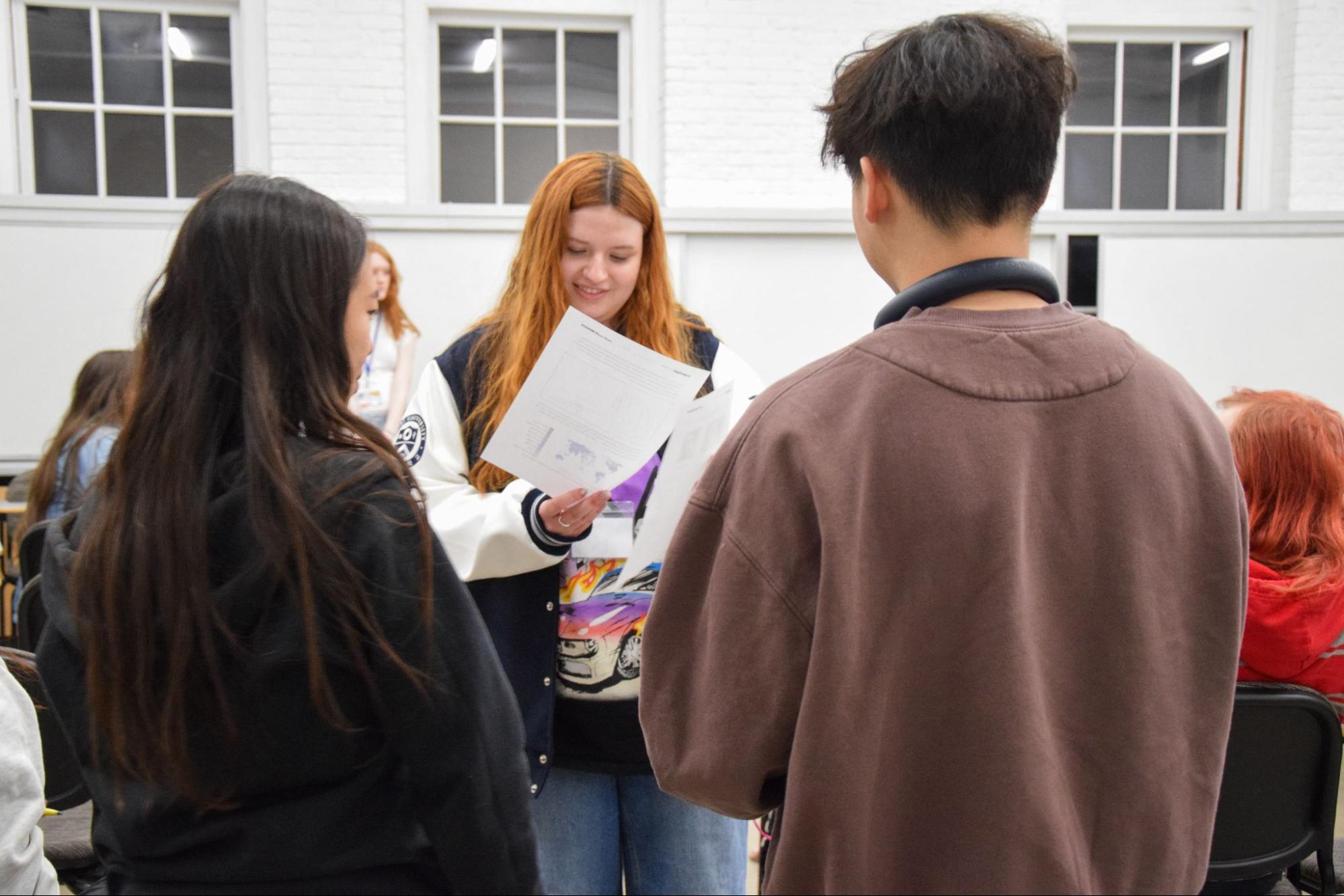
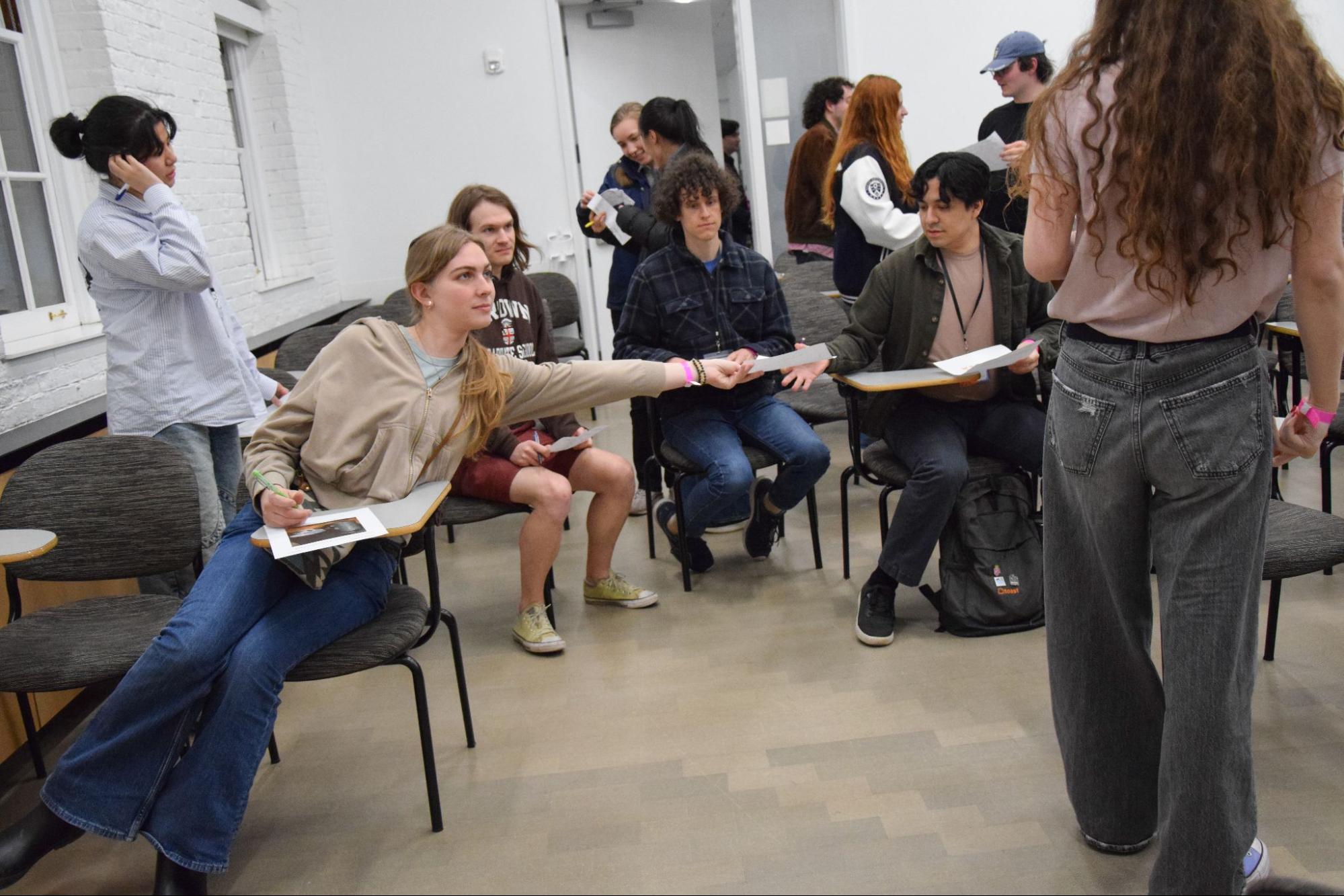
The answer for this event was DIVERSITY OF TOPICS, which is a reference to a cheating scandal that took place in the introductory biology class Diversity of Life last semester, as well as a reference to the wide variety of topics present on the exam we gave solvers.
Thank you to:
- Veronika, Thea, and Amara for helping run the event;
- Thea for her monumental work on the exam design (a magnum opus for any mortal, but she will surely surpass it); and
- Julia for the wonderful pictures!
Here is a link to the full exam, for your enjoyment: exam
Timeline & Logistics
By Megan Carlson and Erin Finn- September 6th: Theme selected
- September 21st: First writing meeting
- October 5th: Meta writing groups formed
- October 26th: Spaghetti meta writing groups formed
- November 9th: Feeder answers released
- November 16th: First art meeting
- November 16th: First feeder puzzle written (Ubpcosu)
- November 22nd–23rd: Puzzlethon!
- November 26th: All metas written (more or less)
- February 8th: First tech meeting
- February 9th: First story meeting
- January 16th–19th: BPH writers go to Mystery Hunt
- January 22nd: SAO security meeting
- January 28th: Puzzles assigned editors
- February 18th: Brown Puzzlehunt 2026 publicly announced!
- March 14th–15th: In-person full testsolve
- March 28th–29th: Remote full testsolve
- April 2nd: Last puzzle written
- April 5th: BPH dry run
- April 5th: Capstone added
- April 11th–12th: In-person hunt!
- April 18th–24th: Remote hunt!
Having a few years of precedent under our belts has taught us a lot about how to put this event together and how to make things work. The timeline was generally smoother than last year! Rooms were booked earlier, feeders dropped sooner, and fewer things were left to do on the night before hunt.
Needless to say, the shocking events at Brown last December introduced complications in planning. All else aside, Brown as a community has cracked down on campus security and willingness to allow guests to access campus. While our hunt is fundamentally by and for Brown students, we strongly believe in making our event accessible to the wider hunt community. Running in-person is part of what makes our event unique, and we are proud to be able to include the community in the physical puzzles, interactions, and events that are only made possible through presence on campus.
We initially received some pushback from administration about hosting guests on campus; the earliest proposal requested that we assign a BPH staff member to accompany each team for the entire duration of the weekend. As much as we love our non-Brown teams, we were not willing or able to accommodate that kind of staffing constraint.
After some back and forth, we settled on a few compromises for how guests could operate on campus. This consisted of ID-checks at kickoff to receive registered participant wristbands, and an HQ ‘burner phone’ manned by hunt staff for building access requests. This meant that anytime a team needed to leave their room and return, they’d need to phone HQ and wait for a student to swipe them in. Although inconvenient for both us and solvers, we feel this was the best compromise manageable considering the situation.
This also meant that we shied away from any puzzles requiring much interaction with campus. While having solvers roaming around looking for landmarks is usually a fun part of being on campus, we decided to clearly signpost any locations required to visit for a puzzle.
We’re unsure how campus security policies will continue to evolve over the course of the next year, but we will continue to advocate for a fun and interactive experience on campus that is accessible to both community members and outside guests.
Testsolving
By Arnav SinghalWe once again enlisted the great and generous help of MIT Puzzle Club for an in-person testsolve and NES for a remote test-solve. These teams are always incredibly constructive and take all of our many pre-hunt flaws in stride, improving pretty much every single puzzle across the two of them. Both teams made a point of writing comments on literally every single puzzle, which was super crucial to see both the strong and weak points of the hunt at those stages!
We were a fair bit more prepared than last year—MIT Puzzle Club only ran into around 6 unwritten puzzles, and NES had 4. We even had the unlock structure decided and implemented before the morning that MITPC arrived!
One particular area that the testsolves were extremely useful in this year was in UI improvements. Both testing teams raised several issues and ideas that made the website progressively easier to navigate and understand.
On a personal note, it’s been lots of fun to hang out with these teams the past two years as they see our (rough) product. Hopefully these relationships turn out to be long-term 😊.
Reflections
In many ways, we can see our hunts getting better each year. Our timeline went smoother, our puzzles were written earlier and tested more thoroughly, and more people got to see our puzzles! Selfishly, we truly believe that our hunt is unparalleled in a lot of ways. Running an in-person hunt is not something that is possible for most running teams, and we know we’re uniquely situated to plan things like physical puzzles, events, and interactions. While these things make hunt weekend crazy for our modest running team, we’re proud that it creates an experience not found elsewhere at this scale.
One of our favorite parts about this hunt is the timeline—dates are set a year in advance and we have from the beginning of September to mid-April to write the hunt. This kind of cycle leaves us with a product we’re proud of every year and has really instilled the truth that perfection is the enemy of things-actually-happening (or however it goes). It’s also really inspiring to see so many puzzle writers and editors go from not knowing what a puzzle is to writing and improving puzzles to such a high standard that only came for some of us after years of doing puzzlehunts.
We’re proud of the community we’ve built around this hunt and within our club. With the last remaining writers of the first Brown Puzzlehunt graduating this year, our hunt leadership is transitioning to a newer generation who were introduced to puzzles through our club! It’s inspiring to see how many undergraduates have fallen in love with puzzles through our community, and we can only hope that BPC will stay strong in years to come.
Exit Survey & Credits
Thanks so much for solving our fourth annual hunt! We’re always trying to improve our event and would love any feedback you have for us. Find our feedback form here.
If you’d like to support Brown Puzzle Club to enable us to keep doing cool things like this in the future, you can do so here.
A full list of credits can be found at the bottom of the info page.
Statistics
Fewest Guesses (Finishers)
Most Guesses (Finishers)
Fewest Hints (Finishers)
Most Hints (Finishers)
Most Hints & Replies (Finishers)
Puzzle Statistics
Common Incorrect Answers
*Relative to puzzle answer.